Northern Ohio winters are brutal on garage floors — and they're especially brutal on epoxy coatings that weren't built to handle them. If your epoxy garage floor is peeling, yellowing, cracking, or showing signs of failure, you're facing a decision: patch it and hope for the best, or upgrade to a system that's engineered for the conditions your floor actually faces.
At Diamond Concrete Coating, we recommend polyaspartic coatings as the superior replacement for failed epoxy. Here's why — and what the upgrade process actually looks like.
Why Epoxy Garage Floors Fail in Ohio
Epoxy was never designed for the conditions inside a Northeast Ohio garage. Snow, slush, and road salt get tracked in daily during winter months. Temperatures inside an unheated garage can swing from below freezing at night to above 50°F on a sunny afternoon. That constant expansion and contraction cracks rigid epoxy coatings.
Add moisture intrusion from beneath the concrete slab (common in Ohio), UV exposure from open garage doors, and the chemical assault from deicers and automotive fluids — and you have a perfect recipe for coating failure.
Why Choose Polyaspartic Instead of Epoxy
Polyaspartic coatings are a type of polyurea — they share the same chemical family but are specifically formulated for use as topcoats and standalone coating systems. Here's what makes them the right choice for Ohio garages:
- ✓Flexibility — Polyaspartic flexes with concrete as it expands and contracts through freeze-thaw cycles, rather than cracking like rigid epoxy.
- ✓UV Stability — Won't yellow or fade from sunlight exposure through open garage doors.
- ✓Fast Cure — Cures in hours rather than days, allowing you to use your garage the next morning.
- ✓Chemical Resistance — Creates a seamless, non-porous surface resistant to water, salt, oil, gasoline, and chemical spills.
- ✓Slip Resistance — Provides a textured finish for safer footing in wet winter conditions.
- ✓Long-Lasting Appearance — Maintains its glossy, showroom finish with minimal maintenance for years.
The Replacement Process
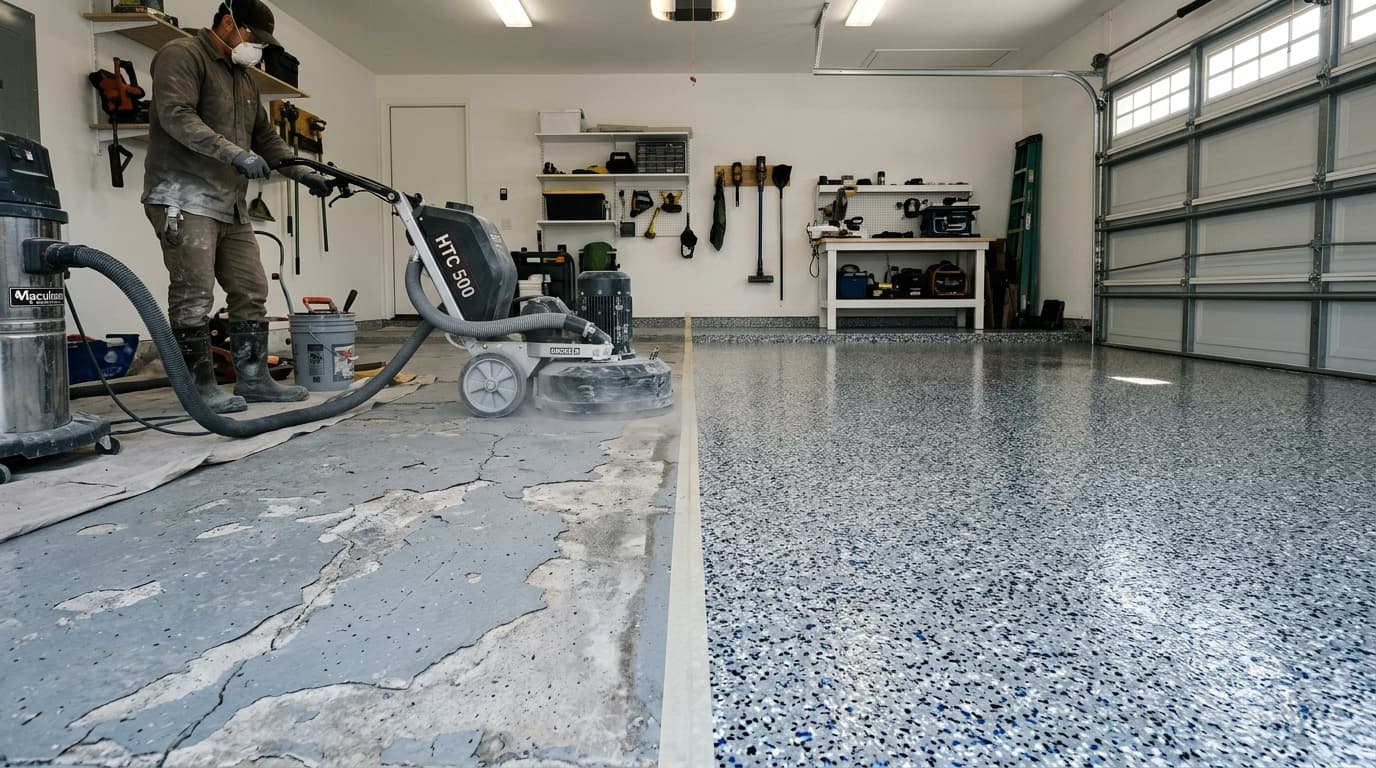
Replacing a failed epoxy floor isn't as simple as applying a new coating over the old one. The existing epoxy must be completely removed to ensure proper adhesion of the new system. Here's how we do it:
- ✓Industrial Diamond Grinding — We mechanically remove the failed epoxy and profile the concrete surface in a single step. This opens the pores of the concrete for maximum adhesion.
- ✓Surface Inspection — We check for cracks, moisture issues, and any concrete damage that needs repair before coating.
- ✓Crack and Joint Repair — Any damaged areas are filled and leveled to create a smooth, uniform surface.
- ✓Polyaspartic Application — Our trained technicians apply the base coat, decorative flakes or solid color, and UV-stable topcoat with precision.
- ✓Same-Day Cure — Light foot traffic is typically possible within hours. Full vehicle traffic by the next morning.
A Stylish and Practical Upgrade
Beyond performance, polyaspartic coatings offer a range of aesthetic options that epoxy can't match. Choose from multiple colors and decorative flake blends to create a floor that complements your home. The high-gloss finish brightens your garage and makes the space feel larger and more finished.
And because the surface is seamless and non-porous, cleaning is effortless — a quick sweep or mop is all it takes to keep your floor looking like it was installed yesterday.
Is the Upgrade Worth It?
If your epoxy floor has failed, you have two realistic options: reapply epoxy and face the same problems again in a few years, or upgrade to polyaspartic and get a floor that's engineered to last through Ohio winters.
The upfront cost of polyaspartic is modestly higher than epoxy — but when you factor in the longer lifespan, zero maintenance costs, and no need for re-coating every few years, it's the more economical choice over the life of your garage floor. Every Diamond Concrete Coating residential project comes with a 15-year warranty.