
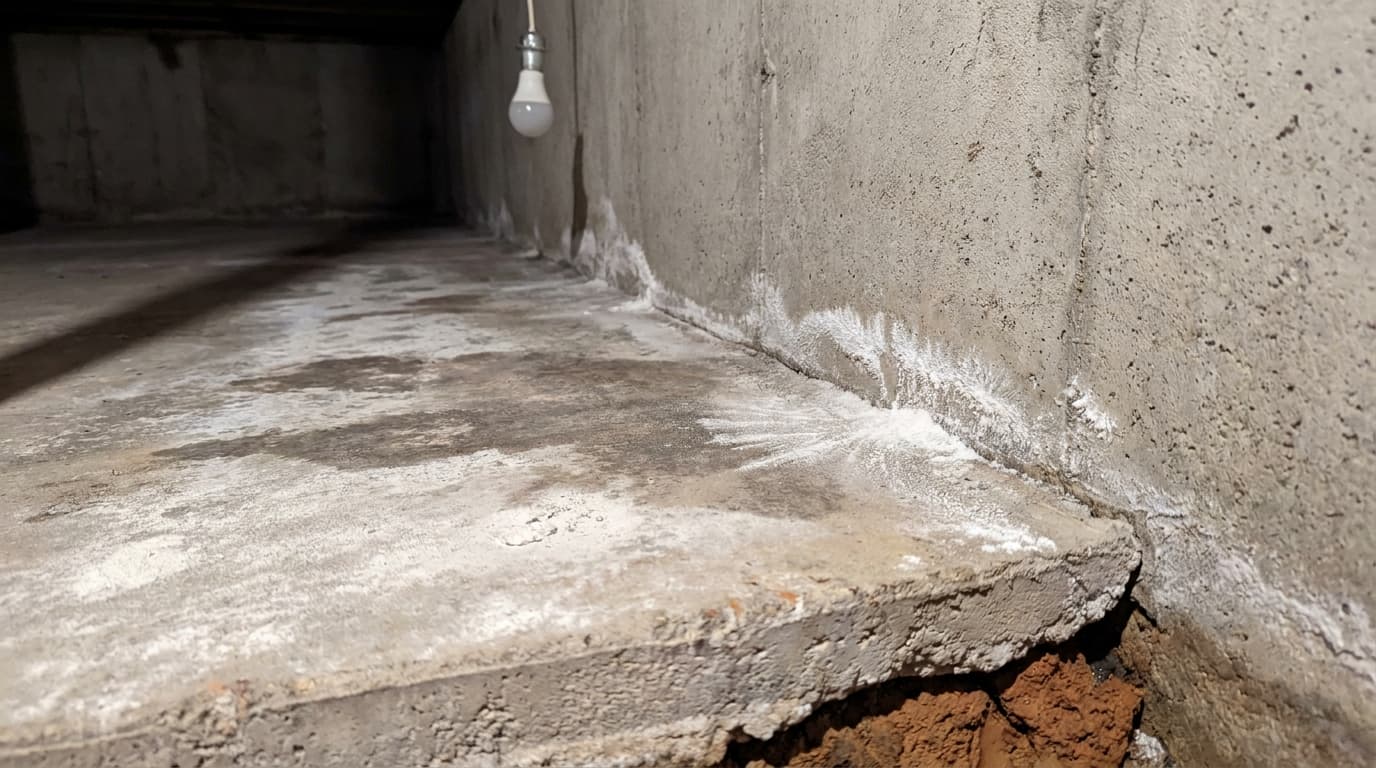
Most basement floor coatings in Northeast Ohio fail because of the clay-bowl effect: the heavy, clay-rich soil around your foundation holds water like a saucer, generates hydrostatic pressure against your walls and slab, and pushes moisture vapor upward through the concrete. That vapor delaminates rigid coatings like epoxy within months. A moisture-tolerant polyurea base coat — paired with mandatory pre-installation moisture testing — is the only coating type that reliably survives clay-soil basements in Cleveland, Lakewood, Parma, and the rest of Cuyahoga County long-term.
If your last basement coating peeled, bubbled, or turned chalky white at the edges, the contractor probably blamed the product. The product wasn't the problem. The soil under your house was. This guide walks through exactly what's happening beneath your slab, how to test for it yourself, and what a coating system actually has to do to survive an Ohio basement.
What is the clay-bowl effect, and why is it worse in Northeast Ohio?
When your foundation was excavated, the contractor dug a hole, poured the footers and walls, and then backfilled around the foundation with the same soil they pulled out. In most of Northeast Ohio, that soil is dense glacial-till clay — the legacy of the Wisconsin glaciation that scraped across this part of the state roughly 14,000 years ago. It's the same clay that makes your backyard pond hold water and your sump pump run after every storm.
Here's the problem: the disturbed backfill clay is more permeable than the undisturbed native clay surrounding it. Rainwater, snowmelt, and runoff find the path of least resistance — straight down into the backfill ring around your foundation. The undisturbed clay underneath holds that water in place. Your foundation is sitting in a literal bowl of saturated clay. That's the clay-bowl effect, and it's not theoretical. It's the geological reality of nearly every basement built in Cuyahoga, Lorain, and Medina County.
Northeast Ohio makes it worse than almost anywhere in the country for three reasons. First, lake-effect precipitation dumps 35-plus inches of rain and 60-plus inches of snow on us annually. Second, our freeze-thaw cycles drive that water deeper into the soil through expansion and contraction. Third, our clay content is exceptionally high — Cuyahoga County soil maps show clay percentages above 40% across most of the inner-ring suburbs. Your basement isn't dry. It's just a question of how the moisture is showing up.
How does basement moisture actually destroy a floor coating?
Three mechanisms, all driven by the same clay-bowl source: vapor transmission, hydrostatic pressure, and efflorescence. Most failed basement floors show all three at once.
**Vapor transmission** is the quiet killer. Even a basement that feels bone-dry is constantly transmitting water vapor up through the slab — the calcium chloride test (more on that below) typically reads 5 to 15 pounds per 1,000 square feet per 24 hours in a Cleveland basement. That vapor has to go somewhere. If you've sealed it under a rigid, non-breathable coating like epoxy, it builds pressure at the bond line between the coating and the concrete. Within months, you get bubbling, blistering, and full delamination. The coating literally floats off the slab.
**Hydrostatic pressure** is the violent version. When the clay around your foundation saturates after a heavy rain or spring thaw, the water table under your slab rises. That water pushes upward on the underside of your concrete with measurable force — sometimes enough to crack the slab itself, almost always enough to defeat any coating that isn't designed for vapor transmission. This is why you see peeling concentrated near floor drains, sump pits, and the perimeter where the slab meets the foundation wall.
**Efflorescence** is the white, chalky, crystalline residue you've seen on basement walls and floors. It's salt — calcium and sodium compounds — dissolved out of the concrete itself and carried to the surface by moving water vapor. When efflorescence forms under a coating, it lifts the coating off the slab from below. When it forms on top of a coating, the coating already failed. Either way, efflorescence is evidence that moisture is moving through your concrete, and any coating installed without addressing it will fail the same way.
How can you tell if your basement has a moisture problem? (DIY plastic-sheet test)
Before you call anyone for an estimate, run the plastic-sheet test. It costs nothing, takes 48 hours, and tells you most of what you need to know. ASTM D4263 is the formal name. Any homeowner can do it.
- ✓Cut a 2-foot by 2-foot square of clear plastic sheeting — a piece of a heavy-duty contractor trash bag works.
- ✓Pick a spot on your basement floor that represents the typical condition — not directly under a sump pit, but not against the driest wall either. Middle of the floor is ideal.
- ✓Tape all four edges of the plastic square down tight to the slab with duct tape or painter's tape. The seal needs to be complete — no air gaps.
- ✓Leave it alone for 48 to 72 hours.
- ✓Lift the plastic. Check both the underside of the plastic and the concrete underneath. Look for condensation droplets, darkening of the concrete, or a damp feel to the slab.
If the underside of the plastic is dry and the concrete looks identical to the surrounding floor, you have a low-vapor slab — uncommon in Northeast Ohio, but it happens. If the plastic shows condensation or the concrete underneath is visibly darker than the surrounding slab, you have active vapor transmission. That's the most common result in our market. It doesn't mean your basement can't be coated. It means your basement can't be coated with epoxy.
The plastic-sheet test is a screen, not a measurement. Before we coat any basement, we follow up with a quantitative calcium chloride test (ASTM F1869) that gives us pounds of moisture per 1,000 square feet per 24 hours. That number determines whether your slab is in spec for a polyurea system as-is, needs a primer or vapor mitigation layer, or shouldn't be coated at all until the source is addressed.
Why does epoxy fail in Ohio basements but polyurea doesn't?
Three properties separate them, and all three matter in a clay-soil basement: vapor tolerance, flexibility, and bond chemistry.
Epoxy is a rigid, non-breathable thermoset. Once it cures, it's essentially a sheet of plastic glued to your concrete. Moisture vapor coming up through the slab has nowhere to escape, so it builds pressure underneath until the coating delaminates. Manufacturers publish maximum moisture limits — usually around 3 pounds per 1,000 square feet per 24 hours — and almost no Northeast Ohio basement reads that low. Installing epoxy on a typical NEO basement slab is installing a coating against its own published spec sheet. It will fail. It's only a question of when.
Polyurea is a flexible elastomer with measurable vapor permeability built into the chemistry. The base coat that goes down on your slab tolerates moisture vapor moving through it instead of trapping it. The polyaspartic topcoat that goes on top is UV-stable and abrasion-resistant for finished-basement use, but the layer underneath — the polyurea base — is what makes the system survive an Ohio clay-bowl slab.
The bond chemistry matters too. Properly profiled concrete (diamond-ground, never acid-etched) gives polyurea a mechanical and chemical bite into the slab surface. Even when vapor is moving through, the bond line holds. We've coated Cleveland and Lakewood basements with measured moisture readings above 7 lbs that are now five-plus years in with zero delamination. That doesn't happen with epoxy in this market.
What does proper moisture testing look like before coating?
When Diamond comes out for a basement estimate, the moisture test isn't an upsell. It's part of the estimate. We run two things: the ASTM D4263 plastic-sheet test you can do yourself (we bring our own sheets) and a quantitative ASTM F1869 calcium chloride test that gives us a real number.
The calcium chloride test is a sealed dish of anhydrous calcium chloride taped to your slab for 60 to 72 hours. Calcium chloride is hygroscopic — it pulls moisture out of the air above it. We weigh the dish before and after, calculate the moisture gain, and convert it to pounds per 1,000 square feet per 24 hours. Below roughly 5 lbs, your slab is in spec for our standard polyurea base. Between 5 and 8 lbs, we typically add a moisture mitigation primer. Above 8 lbs, we either install a full vapor barrier system or, in some cases, recommend addressing the source before coating.
Any contractor quoting a basement coating without measuring moisture is guessing. We've torn out more than one $4,000 basement epoxy job that failed inside 18 months because nobody ran a calcium chloride test before installation. The test costs us about $30 in materials per basement. There's no excuse for skipping it.
Can a basement with moisture issues still be coated?
In almost every case, yes — but the system has to match the slab. Three scenarios cover most Northeast Ohio basements.
**Moderate vapor (5–8 lbs):** This is the majority of our basement coating jobs. We install a moisture-tolerant polyurea base coat directly on the diamond-ground slab, broadcast the decorative flake, and finish with the polyaspartic topcoat. Standard 15-year warranty. We have basements in Parma and Lakewood at this moisture range going strong since 2020.
**High vapor (8–12 lbs):** We add a vapor mitigation primer between the bare concrete and the polyurea base coat. It's a single-component epoxy designed specifically as a vapor barrier — not as a finish floor. The polyurea bonds to the primer, and the primer blocks vapor at the slab. This adds about $1 per square foot to the install but keeps the system in our 15-year warranty.
**Active water intrusion (12+ lbs, visible seepage, standing water):** This is the scenario where we recommend stopping. No coating will survive standing water or active hydrostatic intrusion. The source needs to be addressed first — interior French drain, exterior waterproofing, sump system upgrade, or grading correction outside the foundation. Once the active water is controlled, we re-test and proceed. We'd rather lose the job today than warranty a floor that's going to fail in a year. More on the bigger picture in our basement floor coating Cleveland guide.
When is a coating not the right answer? (honest counterpoint)
A coating is the wrong answer when the source of the moisture is bigger than the coating can manage. We turn down basement jobs every month. A few examples of when we say no — or say not yet.
If your sump pump runs constantly during normal weather, you don't have a coating problem. You have a drainage problem. A coating installed before that's fixed is going to fail at the perimeter no matter what chemistry we use.
If your foundation walls show active seepage — wet spots that come and go with rain, salt staining that returns after you wash it off, or visible cracks weeping water — the wall is the source, not the floor. Coating the floor doesn't stop wall-driven moisture from finding its way under the coating eventually.
If your calcium chloride test comes back above 12 lbs with no obvious cause, something larger is happening underneath. A failed footer drain, a broken downspout discharge, or a grading problem outside is pushing water at the slab faster than any coating can handle. The honest answer is to find and fix the source.
We're a coatings company. We sell coatings. But we don't sell coatings that won't last. If your basement isn't ready for one, we'll tell you that on the estimate and point you toward the right next step. The basement and indoor spaces service page covers what we do install — and the conditions we install it in.
Frequently Asked Questions
Does every Ohio basement have moisture issues?
Most do, to some degree, even if the basement feels dry. The typical Cleveland-area basement slab reads between 5 and 10 pounds per 1,000 square feet per 24 hours on a calcium chloride test. That's enough vapor to destroy epoxy and not enough to feel damp to the touch. Feeling dry isn't the same as being dry — that's why we test every slab before quoting a coating.
What's the plastic-sheet test, and how accurate is it?
Tape a 2-foot by 2-foot square of clear plastic to your slab, seal all four edges, and check it after 48 hours. If you see condensation under the plastic or darkening on the concrete, you have active vapor transmission. It's a yes/no screen, not a measurement — but it's accurate enough to tell you whether you need a quantitative calcium chloride test before any coating gets quoted. Diamond runs both on every basement estimate.
Will polyurea cure a basement moisture problem?
No coating cures the source of basement moisture. Polyurea tolerates vapor transmission where epoxy can't, so the coating itself survives, but the underlying clay-soil hydrostatic pressure is still there. If you have active water intrusion — standing water, wet spots, a sump pump running nonstop — that needs to be addressed with drainage or waterproofing before any coating goes down. Polyurea is the right floor finish for an NEO basement, but it's not a foundation repair.
How much moisture is too much for a coating?
We measure with an ASTM F1869 calcium chloride test. Below roughly 5 pounds per 1,000 square feet per 24 hours, your slab is in spec for our standard polyurea base. Between 5 and 8 lbs, we add a moisture mitigation primer. Above 8 lbs, we install a full vapor barrier system or recommend addressing the source first. Above 12 lbs with visible seepage, we typically decline the job until drainage is fixed.
Why does efflorescence keep coming back even after I scrub it off?
Because the moisture source under your slab keeps pushing dissolved salts to the surface. Scrubbing off the white residue removes the symptom, not the cause. As long as vapor is moving through the concrete, efflorescence will keep forming. A properly installed polyurea system stops new efflorescence from forming on top of the coating — but it doesn't change what's happening inside the slab. That's why moisture testing matters more than cleaning.
Do you coat basements with sump pumps running?
Often, yes — but it depends on how often the pump runs and whether the pit stays dry between cycles. A sump that runs a few times a day after rain is normal in a Cleveland or Lakewood basement and isn't a deal-breaker. A sump that runs every 15 minutes year-round is a sign of a bigger drainage issue, and we'd want to understand the source before quoting a coating. Every situation is different — we assess each one in person.
What's the warranty if my basement has clay-soil moisture?
Our 15-year warranty applies when we've tested and approved the slab for coating. That's the whole point of the moisture test on the estimate — we're confirming that the system we install is going to last. If the slab tests in spec and we install our polyurea base with the polyaspartic topcoat, the 15-year warranty covers peeling, delamination, and material failure. Same warranty whether you're in Cleveland, Lakewood, or Parma — and the same warranty on residential and commercial.
Free in-basement moisture test with every Diamond estimate — call 440-821-7220.