Basement floor coating in Cleveland, OH is not a luxury — it's a defense strategy. If you own a home anywhere in Greater Cleveland, Akron, or the surrounding suburbs, your basement concrete is under constant assault from moisture vapor, temperature swings, and the general hostility of Northeast Ohio's climate.
Most Cleveland basements share the same story: cold, damp concrete that collects dust, stains, and that unmistakable musty smell. The slab sweats in summer, freezes in winter, and slowly deteriorates year after year. Paint peels. Cheap sealers fail. And the basement stays a place you tolerate rather than use.
It doesn't have to be that way. A properly applied basement floor coating transforms raw concrete into a clean, sealed, moisture-resistant surface — and when done right, it lasts well over a decade. But "done right" is the operative phrase. The wrong product, the wrong prep, or the wrong contractor turns a basement floor coating into an expensive lesson. This guide covers everything you need to know before you commit.
Basement Floor Coating Options Compared: Polyurea vs. Epoxy vs. Paint
When homeowners start researching basement floor coating options, three materials dominate the conversation: concrete paint, epoxy, and polyurea/polyaspartic coatings. They are not interchangeable, and choosing the wrong one for a basement is the single most common mistake we see.
Concrete paint is the cheapest option and the most tempting for DIYers. It sits on the surface rather than bonding to it, which means it peels, chips, and wears through — often within a year in a basement environment. It offers zero moisture protection. For a space that gets occasional foot traffic and nothing else, paint is tolerable. For a real basement floor coating, it's inadequate.
Epoxy is a significant step up from paint. It bonds to the concrete, creates a harder surface, and resists stains reasonably well. But epoxy has a critical weakness in basement applications: it is not moisture-tolerant. Epoxy requires a bone-dry slab to adhere properly, and most Ohio basements can't deliver that. When moisture vapor pushes up through the concrete — which it does in most homes east of the Rockies — epoxy delaminates. You get bubbling, peeling, and white patches within months.
Polyurea and polyaspartic coatings are the best coating for basement floors in climates like ours. They're chemically engineered to be flexible, moisture-tolerant, UV-stable, and dramatically more durable than epoxy. Polyurea bonds to diamond-ground concrete at a molecular level and flexes with the slab as it expands and contracts through Ohio's temperature cycles. It handles moisture vapor transmission rates that would destroy an epoxy system. And it cures in hours, not days.
- ✓Concrete paint: $0.15–$0.50/sq ft — lowest cost, lowest durability, no moisture protection, peels within 1–2 years in most basements.
- ✓Epoxy coating: $3–$5/sq ft installed — moderate durability, poor moisture tolerance, yellows with UV exposure, 2–5 year lifespan in basement conditions.
- ✓Polyurea/polyaspartic coating: $7–$10/sq ft installed — highest durability, moisture-tolerant, UV-stable, flexible through freeze-thaw, 15+ year lifespan with proper installation.
How Much Does Basement Floor Coating Cost in Cleveland?
Cost is usually the first question, so let's address it directly. Basement concrete coating cost in the Cleveland market depends on the system you choose, the size of your space, and the condition of your existing concrete.
For a professional polyurea basement floor coating — which is what we install and recommend — expect to pay between $7 and $10 per square foot installed. That includes surface preparation with diamond grinders, crack and joint repair, the full coating system (base coat, decorative flake or solid color, and UV-stable topcoat), and cleanup.
Here's what that looks like for typical Cleveland basement sizes:
- ✓500 sq ft basement: $3,500–$5,000
- ✓750 sq ft basement: $5,250–$7,500
- ✓1,000 sq ft basement: $7,000–$10,000
Several factors can push the price toward the higher end. Significant moisture mitigation — if your slab has elevated moisture vapor readings, additional prep work may be needed before coating. Extensive crack repair or concrete damage adds labor and material. Complex layouts with multiple rooms, tight spaces, or obstacles require more time. And removing a previously failed coating (old paint or epoxy) adds a step to the grinding process.
We give every customer a free on-site estimate because pricing a basement floor coating without seeing the space is guesswork. The condition of your concrete matters more than the square footage.
The Moisture Problem: Why Most Basement Coatings Fail in Ohio
This is the section most contractors skip — and it's the reason most basement floor coatings fail. Basement floor coating moisture is the single biggest variable in whether your coating lasts 15 years or 15 months.
Here's what's happening under your feet: your basement slab sits on soil that holds water. That water creates vapor pressure that pushes moisture upward through the porous concrete. This is called moisture vapor transmission, and in Northeast Ohio — with our high water tables, clay-heavy soils, and seasonal rainfall — it's happening in the majority of basements.
You might not see standing water. Your basement might feel dry. But if you tape a piece of plastic to your basement floor and check it in 48 hours, there's a good chance you'll find condensation underneath. That invisible moisture is enough to destroy an epoxy coating from below.
Epoxy creates a rigid, impermeable membrane. When vapor pressure builds beneath it, the coating literally gets pushed off the concrete. That's why basement floor coating vs epoxy is not a fair comparison in moisture-prone environments — epoxy was never designed for this application.
Polyurea handles moisture differently. Our system is formulated to tolerate higher moisture vapor transmission rates while maintaining full adhesion. Combined with professional moisture testing before application — we test every basement slab before we coat it — this means we can confidently coat basements that would be risky for epoxy installers.
What to Expect During Basement Floor Coating Installation
One of the biggest advantages of a polyurea basement floor coating is speed. Most residential basements are completed in a single day. Here's what the process looks like when Diamond Concrete Coating handles your project.
First, we test the concrete for moisture levels. If the readings are within acceptable range, we proceed. If not, we discuss mitigation options before moving forward — we'd rather delay the project than install over a slab that isn't ready.
Next comes surface preparation — and this is where we differ from most contractors. We use industrial diamond grinders to mechanically profile the concrete surface. This removes any old paint, sealers, or contamination and opens the pores of the concrete for maximum adhesion. We never acid wash. Acid etching is inconsistent, leaves residue, and doesn't create the surface profile that polyurea needs to bond permanently.
After grinding, we repair any cracks, joints, or damaged areas to create a smooth, level surface. Then the coating goes down: base coat, decorative flake broadcast or solid color application, and a UV-stable polyaspartic topcoat that seals everything in.
Cure time is measured in hours, not days. Light foot traffic is typically fine the same evening. Full use of the space — furniture, equipment, daily traffic — is usually possible within 24 hours. For Cleveland homeowners who can't afford to have their basement out of commission for a week, this matters.
Basement Floor Coating Ideas and Trends for 2026
Basements have evolved well past the "storage and laundry" era. Cleveland homeowners are turning their lower levels into home gyms, remote offices, entertainment rooms, and full living spaces — and the floor sets the tone for the entire room.
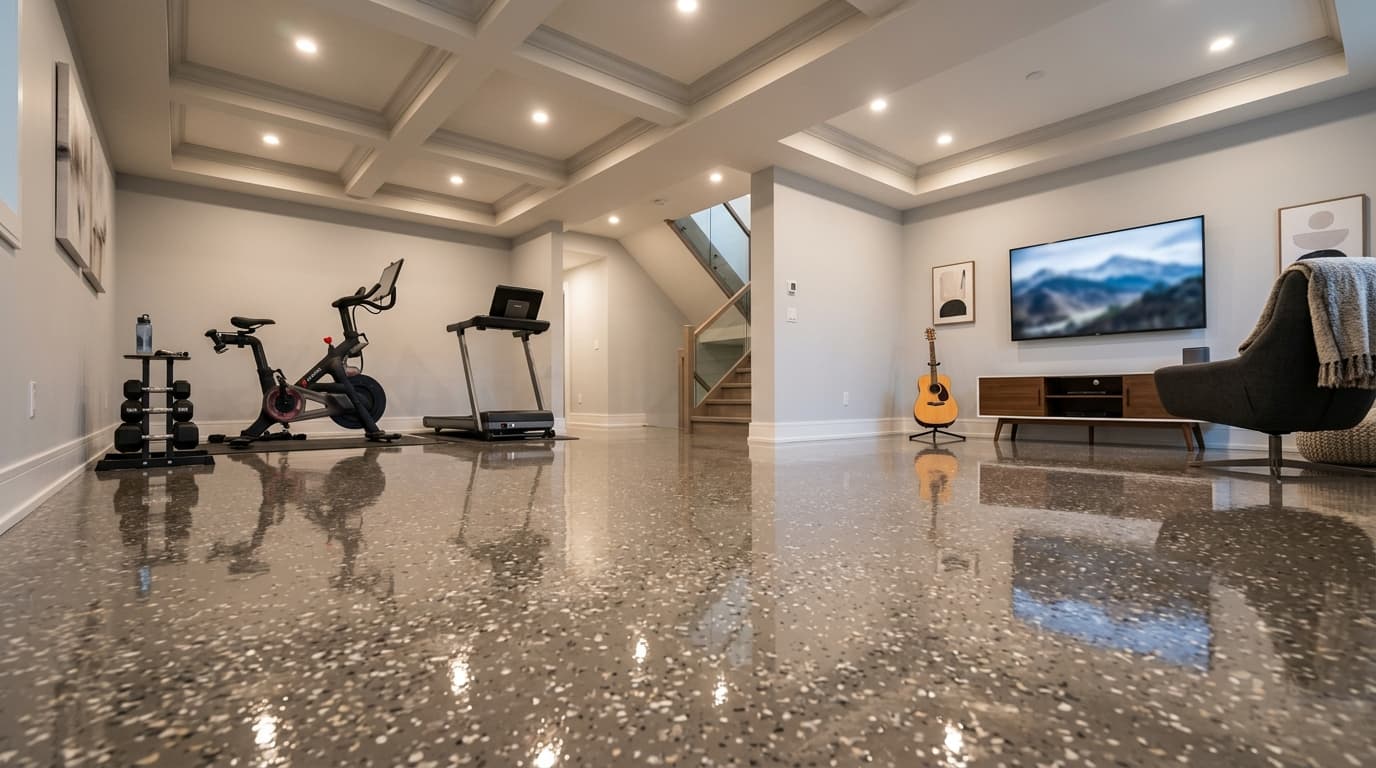
Warm neutrals and earth tones are leading the trend right now. Think warm grays, tans, and subtle beige blends that make basements feel inviting rather than industrial. Charcoal and dark gray remain popular for home gyms and man caves where a bolder look fits the space.
Decorative flake blends are the most popular finish we install in basements. They add depth, hide minor imperfections, and give the floor a granite-like appearance that reads as intentional design — not a utility coating. Full-flake broadcasts create a seamless, textured surface, while partial-flake systems offer a cleaner, more modern look.
For laundry areas and utility rooms, lighter solid colors with a satin finish are practical and popular. They brighten the space dramatically — homeowners are consistently surprised by how much brighter a coated basement feels compared to raw gray concrete.
Frequently Asked Questions About Basement Floor Coating
Can you coat a basement floor with moisture problems? Yes — but it requires professional moisture testing first. Our polyurea system tolerates higher moisture vapor levels than epoxy, and we test every slab before application. If moisture levels are too high, we'll recommend mitigation steps before proceeding rather than coating over a problem.
How long does basement floor coating last? A professionally installed polyurea basement floor coating lasts 15 years or more. Diamond Concrete Coating backs every residential project with a 15-year warranty covering peeling, delamination, and material failure. Cheap paint and DIY epoxy kits typically fail within 1–3 years in basement conditions.
Is basement floor coating slippery? Our standard topcoat provides good traction for everyday use. For areas where water or spills are common — laundry rooms, utility areas, basement entries — we add slip-resistant additives to the topcoat at no extra charge. The result is a textured surface with reliable grip, even when wet.
DIY vs professional basement floor coating — which is better? DIY kits from hardware stores use inferior materials (usually water-based epoxy) and skip the most critical step: proper surface preparation. Without diamond grinding, no coating bonds reliably to concrete. Professional installation with polyurea costs more upfront but eliminates the cycle of coating, failing, stripping, and re-coating that DIY products create.
What's the best time of year to coat a basement floor in Ohio? Basements maintain relatively stable temperatures year-round, which means we can coat them in any season. Unlike garages and outdoor spaces, basement coating isn't weather-dependent. That said, spring and fall tend to be our busiest seasons, so scheduling in winter or early summer often means faster availability.
Get a Free Basement Floor Coating Estimate in Greater Cleveland
If your basement floor is bare concrete, cracking, stained, or coated with something that's already failing — it's time to fix it once and be done. Diamond Concrete Coating serves homeowners throughout Greater Cleveland, Cuyahoga County, Summit County, and Medina County with polyurea floor coatings that are installed in one day and warranted for 15 years.
Call us at 440-821-7220 or request your free on-site estimate online. We'll test your concrete, show you your options, and give you an honest price — no pressure, no gimmicks, no franchise upsell. Just a local, family-owned crew that does this every day and stands behind every floor we coat.