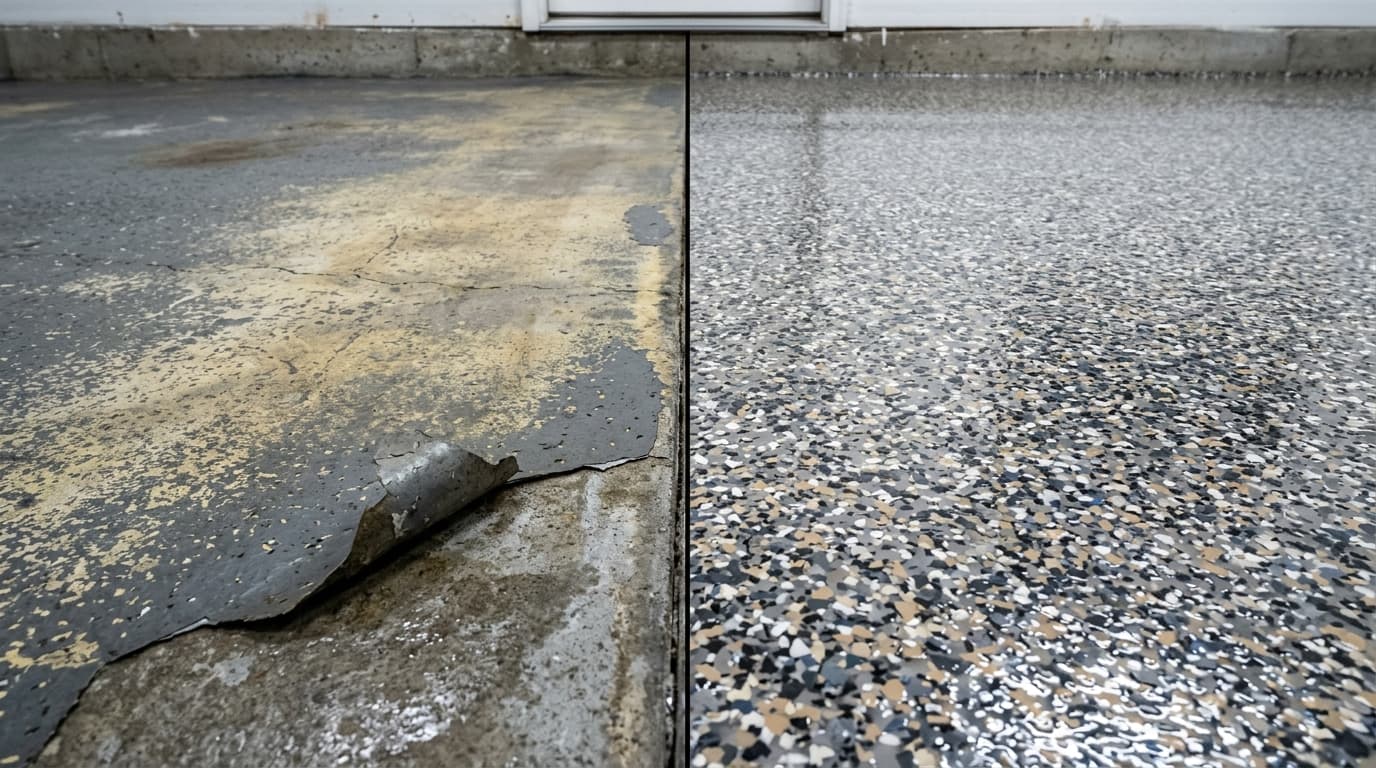
In Ohio winters, polyaspartic outperforms epoxy in every meaningful category: it cures below freezing, flexes through freeze-thaw cycles instead of cracking, resists road-salt corrosion, and lasts 15+ years versus epoxy's 2–5. The trade-off is upfront cost — polyaspartic runs roughly $7–$10 per square foot installed versus $3–$5 for epoxy — but over a 15-year window, polyaspartic is the cheaper system because you only pay to install once.
We get this question every week from homeowners in Cleveland, Strongsville, Akron, and the rest of Cuyahoga and Summit County: "My neighbor got epoxy for half what you quoted me. Why?" The honest answer is that you're not buying the same product, and you're not buying the same lifespan. This guide breaks down the chemistry, the cost, and the 15-year math so you can decide with real numbers instead of a sales pitch.
What's the actual chemical difference between polyaspartic and epoxy?
Epoxy is a two-part thermoset resin — a base resin and a hardener that chemically react to form a rigid plastic film on top of your concrete. It's been around since the 1940s and it's cheap to manufacture. That's the appeal. The problem is that the cured film is rigid, moisture-intolerant, and not UV-stable.
Polyaspartic is a subtype of polyurea, a newer chemistry developed in the 1990s for industrial applications like bridge decks and parking garages. It cures through a reaction between an aliphatic polyisocyanate and a polyaspartic ester. The result is a flexible, UV-stable, moisture-tolerant film that bonds to properly profiled concrete at a near-molecular level.
Three properties matter for an Ohio garage: flexibility, moisture tolerance, and UV stability. Polyaspartic wins all three. Epoxy loses all three. That's not marketing copy — that's chemistry that the manufacturers themselves publish in their own technical data sheets.
How does each coating hold up through an Ohio winter?
An unheated Northeast Ohio garage sees temperature swings from 5°F overnight in January to 55°F on a sunny February afternoon. The concrete slab expands and contracts on every cycle. A coating that can't flex with that movement will crack. A coating that traps moisture against the slab will delaminate. A coating that can't tolerate calcium chloride brine will pit and lift at the edges.
Epoxy fails on all three counts. Within two to five winters in our market, we see the same failure pattern: hairline cracks across the surface, peeling along the garage door threshold where road salt concentrates, yellowing wherever sunlight hits through the open door, and bubbling in spots where moisture vapor from the slab couldn't escape.
Polyaspartic was engineered for exactly this environment. It flexes through the freeze-thaw cycle. It rejects salt brine at the surface. It tolerates moisture vapor pushing up from the slab. And because polyaspartic topcoats are aliphatic, they don't yellow under UV exposure. We have polyaspartic floors in Cleveland garages going on their second decade with no visible degradation. We don't have a single epoxy floor older than five years that hasn't needed work.
What does polyaspartic cost vs. epoxy in 2026?
Here's the part most contractors won't put in writing. We will. These are real Greater Cleveland market numbers for 2026, based on what Diamond Concrete Coating quotes weekly and what the going epoxy rate is for licensed installers in the same market.
Materials
Raw material cost per square foot is where the gap starts. A standard two-coat epoxy system (primer plus pigmented topcoat) runs roughly $0.80–$1.50 per square foot in materials. A full polyaspartic system — moisture-tolerant polyurea base, full decorative flake broadcast, and UV-stable polyaspartic topcoat — runs $2.50–$4.00 per square foot in materials.
Polyaspartic costs more because the chemistry costs more to produce. Aliphatic isocyanates and polyaspartic esters are simply more expensive feedstocks than bisphenol-A epoxy resin. There's no shortcut around that. Any contractor quoting you "polyaspartic" at epoxy prices is either using a hybrid product (epoxy base with a thin polyaspartic topcoat) or cutting the system to a single thin coat. Neither performs like the real thing.
Installation labor and prep
Labor is where the price gap narrows — and where a lot of homeowners get fooled. The right surface prep for either system is industrial diamond grinding. Acid etching, pressure washing, or a stiff broom and a hardware-store cleaner are not surface prep. They're shortcuts that guarantee failure.
A proper diamond-ground, two-coat epoxy install in a 500 sq ft Cleveland-area two-car garage runs roughly $1,500–$2,500 from a reputable contractor. A proper polyaspartic install on the same garage runs $3,500–$5,000. Yes, polyaspartic costs about double. But you're getting a system that installs in one day, cures in hours, and lasts 15+ years.
If someone is quoting you epoxy for $800 on a two-car garage, they're rolling it on bare or acid-etched concrete with no real prep. That floor will start failing before next winter. We rip out a lot of those every spring — see our walkthrough on replacing failed epoxy with polyaspartic for what that looks like in practice.
15-year lifecycle cost comparison
Here's the math that actually matters. Take a 500 sq ft two-car garage in Strongsville. Compare a single polyaspartic install to a realistic epoxy re-coat cycle over 15 years.
- ✓Polyaspartic — one install at $4,500. Total 15-year cost: $4,500. Floor still under warranty at year 15.
- ✓Epoxy (professional) — install at $2,000, fails by year 4, strip and re-coat at $2,500, fails by year 8, strip and re-coat at $2,500, fails by year 12, strip and re-coat at $2,500. Total 15-year cost: $9,500. Floor failing again by year 16.
- ✓Epoxy (DIY kit) — $300 in materials, fails by year 2. Repeat 7 times over 15 years = $2,100 in kits, plus dozens of weekends of your own labor, plus a slab that gets harder to coat each cycle as failed product builds up. Eventually you pay a pro $5,000+ to grind it all off and start over.
The polyaspartic system is roughly half the 15-year cost of professional epoxy, with one install instead of four, and zero downtime between cycles. That's why we don't install epoxy. Not because we can't — because the math doesn't work for the homeowner.
Which coating lasts longer in a Northeast Ohio garage?
Polyaspartic, by a factor of three to seven. Manufacturer-published data puts polyaspartic systems at 15–20+ years in residential garage conditions. Epoxy in the same conditions is rated 3–7 years, and that's in a stable climate. In Northeast Ohio's freeze-thaw and road-salt environment, the real-world epoxy lifespan we see is 2–5 years before visible failure starts.
Diamond's residential polyaspartic install carries a 15-year warranty against peeling, delamination, and material failure. Most epoxy contractors in Cuyahoga and Summit County warranty their work for 1–3 years, often with exclusions for moisture, hot tire pickup, and salt damage — which are precisely the things you need protection against.
Does polyaspartic really install in one day?
Yes, on a typical residential garage. A 500 sq ft two-car garage in Strongsville starts at 8 AM with diamond grinding, gets crack and pit repair before lunch, base coat plus full flake broadcast in the early afternoon, and a UV-stable polyaspartic topcoat by late afternoon. We're off your driveway by 4–5 PM. Light foot traffic that evening. Drive on it the next morning.
Epoxy can't match that timeline because the cure chemistry is slower. Standard epoxy needs 24 hours minimum before light foot traffic and 48–72 hours before vehicles. Plus epoxy can't be installed below 50°F, which knocks out about six months of the Ohio calendar. Polyaspartic cures down to subfreezing temperatures, so we can coat year-round when needed.
See our full garage floor coating service page for the room-by-room breakdown of what one-day installation actually looks like.
When (if ever) is epoxy the better choice?
Honestly? Almost never in Ohio. There are a few narrow scenarios where epoxy makes sense, and we'll name them directly so you have the full picture.
- ✓A climate-controlled, indoor commercial space with no UV exposure, no road salt, and no freeze-thaw — for example, an interior warehouse aisle in a heated building. Epoxy can perform well there for 5–10 years.
- ✓A short-term install where you plan to re-floor the space within 3–4 years anyway — a flip property, a short-term rental, or a structure you intend to demolish.
- ✓A pure budget play where you understand and accept that you are buying a 2–4 year coating, not a permanent floor. If that math works for you, fine. Just don't let a contractor sell it as anything else.
For a Northeast Ohio homeowner who wants their garage floor done once and done right, epoxy is the wrong material. We've written more about why in our breakdown on why we don't install epoxy.
What should I ask a contractor quoting either one?
Most homeowners don't know what to ask, and most contractors take advantage of that. Use this list verbatim on your next estimate call. The answers will tell you immediately whether you're talking to a pro or someone who'll be hard to find next March.
- ✓What surface prep method do you use — diamond grinding, shot blasting, or acid etching? (Correct answer: diamond grinding or shot blasting. Acid etching is a red flag.)
- ✓Is the topcoat aliphatic polyaspartic or aromatic polyurethane? (Aliphatic only — aromatic yellows.)
- ✓How many mils thick is the finished system? (Polyaspartic should be 20–30 mils. Under 15 mils is thin.)
- ✓Is the base coat moisture-tolerant? What moisture vapor transmission rate does it handle?
- ✓What is the written warranty, in years, and what does it specifically exclude?
- ✓How long have you been installing this exact system in Northeast Ohio?
- ✓Do you subcontract the install or use your own crew?
- ✓Can I see three local references with floors at least 5 years old?
- ✓What's the line-item cost for crack and pit repair, separate from the coating?
- ✓If a hot tire lifts the coating in year 3, what does the warranty claim process look like?
Frequently Asked Questions
We field these questions on every estimate call. Here are the straight answers.
Is polyaspartic worth the extra money over epoxy?
Yes in Ohio. The 15-year warranty and freeze-thaw flexibility eliminate the epoxy re-coat cycle. Over a 15-year window in the Cleveland/Akron market, polyaspartic costs roughly half what professional epoxy costs once you factor in the multiple re-installs epoxy requires. You also avoid the downtime, the mess of repeated stripping, and the cumulative damage to your concrete slab.
Can epoxy be applied in winter?
Most epoxies require 50°F+ for proper cure. Polyaspartic cures down to -30°F. In Northeast Ohio that's a meaningful difference — epoxy installation effectively shuts down from November through April in our climate, while polyaspartic can be installed any month of the year. If your garage floor needs work in February, only one of these systems is even an option.
Does polyaspartic yellow like epoxy?
No. Polyaspartic is UV-stable; epoxy yellows within 12–24 months of UV exposure. If your garage door faces south or west and gets afternoon sun through the opening, an epoxy floor will visibly amber-shift in the entry zone within the first year. Polyaspartic stays the color you chose for the life of the floor.
How thick is each coating?
Polyaspartic systems are typically 20–30 mils installed. Residential DIY epoxy kits are often under 10 mils — basically a glorified paint film. Professional rolled epoxy comes in around 12–16 mils. Thickness matters because that's the buffer between road salt, hot tires, dropped tools, and the concrete underneath. Thin coatings fail fast.
Which one is more slip-resistant when wet?
Both can include aggregate. Our polyaspartic topcoat includes slip-resistant additive at no extra charge — every Diamond install gets it standard, because in Ohio your floor will be wet for half the year. Most epoxy contractors charge extra for grit additive, and DIY kits skip it entirely. Without aggregate, both materials are slick when wet.
Can I walk on each the same day?
Polyaspartic: hours. Light foot traffic the same evening, vehicles the next morning. Epoxy: 24–72 hours before foot traffic, 48–96 hours before vehicles, depending on temperature and humidity. For a homeowner who needs the garage back in service quickly, that's a one-day-versus-three-day difference.
What's the actual warranty on each?
Diamond's polyurea/polyaspartic is warrantied 15 years against peeling, delamination, and material failure. Epoxy from most contractors: 1–3 years, often with exclusions for moisture vapor, hot tire pickup, road salt, and freeze-thaw — which covers nearly every realistic Ohio failure mode. Always read the exclusions section. That's where the actual coverage lives.
Get a Side-by-Side Quote in Greater Cleveland
If you're shopping coatings for your Cleveland, Akron, Strongsville, or surrounding-suburb garage and you want real numbers on both options, we'll give them to you. Diamond Concrete Coating only installs polyurea/polyaspartic — but we'll happily walk you through what an epoxy install costs locally, what its real lifespan is, and where the trade-offs land for your specific garage.
Get a side-by-side quote on your garage — free 20-minute on-site estimate, 440-821-7220. Local crew, family-owned, 15-year warranty, no franchise upsell.