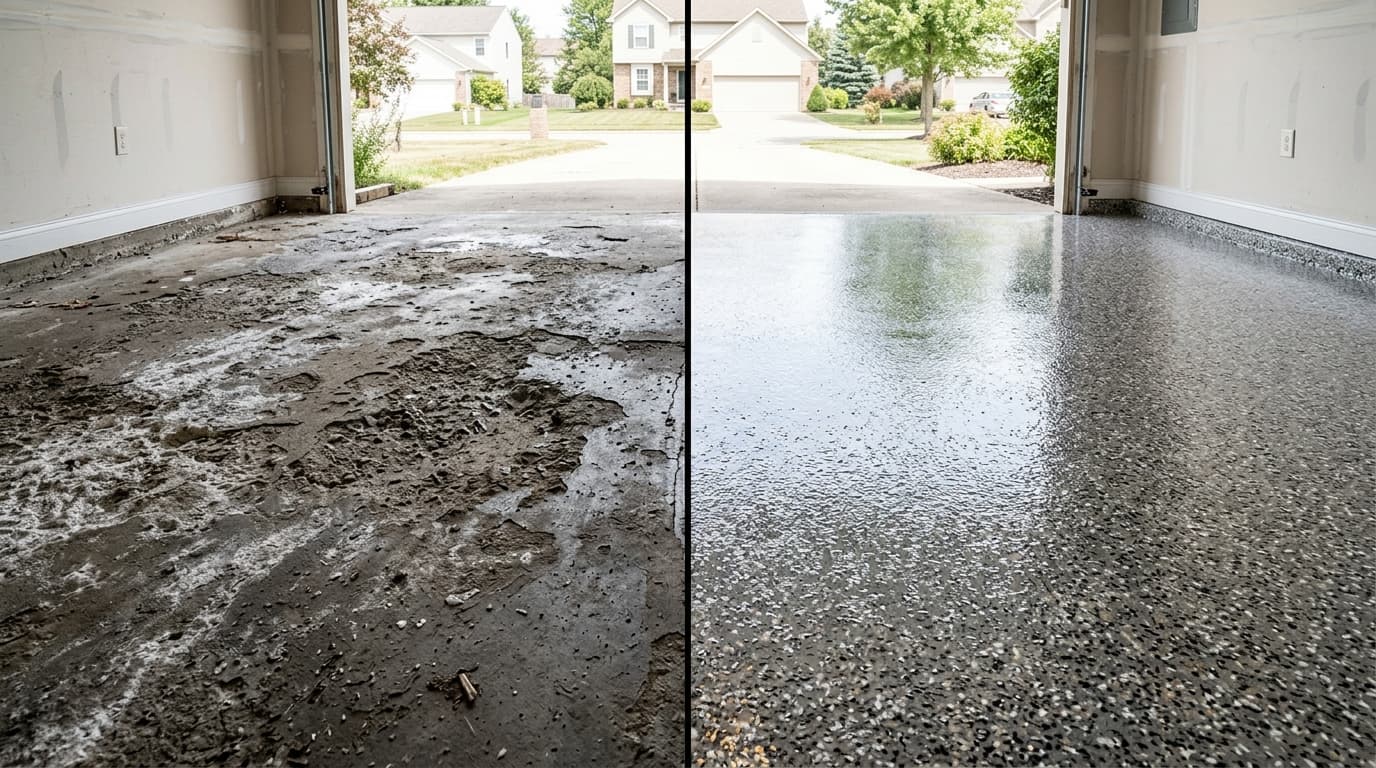
Salt damage on a Northeast Ohio garage floor shows up as pitting, surface flaking, and white powdery efflorescence — the calcium chloride in road deicers chemically attacks concrete and pulls moisture back out as it dries. To repair it permanently, you need to diamond-grind the damaged surface, repair the pits, and install a moisture-tolerant polyurea coating that blocks future salt intrusion. Paint and epoxy will fail within a year in the same conditions.
Every spring we get the same call from Cleveland, Akron, and the surrounding suburbs: the snow melted, the garage floor dried out, and now there's a chalky white crust along the front lip of the slab and dozens of shallow pits wherever the car parks. That's not cosmetic. That's chemistry. And it gets worse every winter you leave it alone.
This guide walks you through exactly what's happening to your concrete, how to tell how bad it is, what a real repair looks like, and what it costs in the Greater Cleveland market in 2026.
What does road salt actually do to a garage floor?
Northeast Ohio uses some of the heaviest deicer loads in the country. Cuyahoga and Summit County road crews lean on rock salt (sodium chloride) and calcium chloride brine to keep roads drivable through lake-effect storms. Every time you pull into the garage, you're carrying that chemistry in under your tires.
Concrete is porous. When salty meltwater sits on the slab, it soaks in. As the water evaporates, salt crystals form inside the concrete's capillary structure and expand. That expansion breaks apart the cement paste from the inside — the same freeze-thaw damage you get from frozen water, but accelerated.
Calcium chloride is the worst offender. It's hygroscopic, meaning it actively pulls moisture out of the surrounding air and concrete, keeping the slab wet long after the snow is gone. That constant wet-dry cycling is what produces the shallow pitting and surface scaling most Ohio homeowners mistake for normal wear.
The white powder you see — that's efflorescence. It's salt and free lime being pushed to the surface by moisture moving through the slab. It's not dangerous, but it's a flashing red light that salt is already inside your concrete.
How can you tell if your garage floor has salt damage?
Salt damage has a distinctive look once you know what you're staring at. Walk into your garage in good light and look for these signs:
- ✓Pitting — shallow, dime-sized to quarter-sized divots, usually clustered where tires sit or along the garage door threshold.
- ✓Surface scaling or flaking — the top 1/16"–1/8" of concrete peeling off in thin sheets or crumbling under a boot heel.
- ✓White powder or crust (efflorescence) — chalky deposits along the front lip, cracks, or joints.
- ✓Darker stained rings — where salt-laden water puddled and dried, leaving a halo.
- ✓Rough, sandy texture — if you run your hand across the slab and it feels gritty, the cement paste is already breaking down.
- ✓Hairline surface cracks radiating out from pits — an early warning that damage is spreading laterally.
If you see three or more of those signs, you have active salt damage. The good news: it's almost always a surface issue, not a structural one. The bad news: it won't stop on its own, and every Ohio winter compounds it.
Can a salt-damaged garage floor be fixed, or does it need to be replaced?
Ninety-five percent of the salt-damaged floors we see in Northeast Ohio can be repaired without tearing out the slab. The damage is concentrated in the top quarter-inch of concrete. Below that, the slab is usually sound.
Replacement only makes sense in rare cases: deep structural cracking through the full slab, widespread sinking or heaving from a failed sub-base, or decades of untreated damage that's eaten more than half an inch of surface. For everything else, the fix is mechanical surface prep plus a proper coating system.
What does not work: sealer, concrete paint, or a DIY epoxy kit from the hardware store. Sealer over pitted concrete just highlights the pits. Paint traps moisture against the already-damaged surface and starts peeling within a season. DIY epoxy needs a clean, dry, chemically stable slab to bond — three things a salt-damaged Ohio floor doesn't have. If you're in that boat already, our guide on replacing a failed epoxy garage floor with polyaspartic walks through that specific scenario.
A professional polyurea/polyaspartic system is the only repair that holds up long-term in our climate. Here's the process we run on every salt-damage job.
What's the step-by-step process to repair salt-damaged concrete?
Every Diamond Concrete Coating salt-damage repair follows the same three-stage sequence: grind, repair, coat. Start to finish, a typical two-car garage is done in a single day.
Step 1: Diamond grinding the damaged surface
We start with industrial diamond grinders — not acid wash, not pressure washing, not a stiff broom. Diamond grinding mechanically removes the top layer of salt-contaminated, scaled concrete and exposes clean, sound material underneath.
This step does three things at once: it takes off the damaged surface, it opens the pores of the concrete so the coating can mechanically bond, and it removes any residual salt that would otherwise keep pulling moisture into the slab for years. Acid etching doesn't accomplish any of those goals reliably — it's inconsistent, leaves chemical residue, and doesn't create the surface profile polyurea needs.
After grinding, the floor looks matte and slightly rough, like fine sandpaper. That's the profile we want.
Step 2: Repairing pits and micro-cracks
Once the surface is ground clean, every pit, joint, and hairline crack gets individually repaired. We use a cementitious patching compound for shallow pits and Diamond's Liquid Metal crack-filling product for anything deeper or wider. The goal is a dead-flat, structurally continuous surface before any coating touches it.
This is where most low-bid contractors cut corners. They'll skim a thin coating over pitted concrete and call it done. Six months later, every pit telegraphs through the finish and the coating starts lifting at the edges. If your estimate doesn't spell out crack and pit repair as a separate line item, ask why.
Step 3: Applying a polyurea/polyaspartic coating system
With the slab ground and repaired, we install a full polyurea/polyaspartic system. Diamond only installs polyaspartic with a decorative flake broadcast — no epoxy, no painted floors, no watered-down hybrid systems. Learn more about our full garage floor coating service and what's included.
The sequence: a moisture-tolerant polyurea base coat goes down first. While it's still tacky, our crew broadcasts decorative color flake across the entire floor — this is what gives the finished floor its texture and the granite-like look homeowners recognize. After the base cures, we scrape off loose flake, vacuum, and apply a UV-stable polyaspartic topcoat that locks everything in and seals the slab against future salt intrusion.
Total on-site time for a 500 sq ft two-car garage: roughly 6–8 hours. Light foot traffic that evening. Drive on it the next morning.
Why does polyurea hold up to Ohio road salt when epoxy doesn't?
Polyurea and epoxy are fundamentally different materials. Epoxy is rigid and moisture-intolerant. Polyurea is flexible and designed to tolerate the exact moisture-vapor and temperature-swing environment that Ohio garages live in.
Three things matter for salt resistance: chemical barrier, flexibility, and moisture tolerance. Polyurea wins on all three. It creates a seamless, non-porous barrier that calcium chloride can't penetrate. It flexes through freeze-thaw cycles as your slab expands and contracts from 10°F at night to 55°F on a sunny February afternoon. And it tolerates moisture vapor pushing up from the slab — something epoxy cannot do without delaminating.
That's why we've walked into dozens of Cleveland and Akron garages and found two-year-old epoxy floors already peeling at the garage door, with fresh salt damage visible underneath. The epoxy didn't fail because the installer was bad. It failed because epoxy was never engineered for an Ohio garage.
How much does it cost to repair a salt-damaged garage floor in Ohio?
A full polyurea/polyaspartic repair and coating in the Greater Cleveland market runs $7–$10 per square foot installed in 2026. That includes diamond grinding, pit and crack repair, the full coating system (base, decorative flake, UV topcoat), cleanup, and our 15-year warranty.
Here's what that looks like by garage size:
- ✓1-car garage (~250 sq ft): $1,750–$2,500
- ✓2-car garage (~500 sq ft): $3,500–$5,000
- ✓3-car garage (~750 sq ft): $5,250–$7,500
- ✓Detached shop or oversized bay (~1,000 sq ft): $7,000–$10,000
What moves you toward the higher end: extensive pit and crack repair on a badly weathered slab, removal of a previously failed coating (old paint or peeling epoxy), complex layouts with interior walls or obstacles, or custom flake blends and designer color palettes.
A quick reality check: DIY epoxy kits run $200–$400 per garage. They fail within 1–2 Ohio winters. Over a 15-year window, three DIY attempts plus the labor to strip each failure actually cost more than one professional polyurea install — and you still end up with a damaged floor at the end of it. If you're still shopping contractors, our checklist on what to look for when searching "garage floor coating near me" covers the questions worth asking before you sign anything.
How do you prevent salt damage after the repair?
Once a polyurea/polyaspartic system is down, the hard work is done. The coating itself is the prevention. But a few habits keep the floor looking showroom-new through Northeast Ohio's worst months:
- ✓Rinse the floor with plain water a few times per winter — especially after the first few weeks of heavy road-salt treatment.
- ✓Keep a rubber mat or drip tray under each vehicle during the January–March snow-belt stretch to catch the worst of the melt.
- ✓Wipe up standing slush or puddles that pool near the garage door threshold within a day or two.
- ✓Use a neutral-pH cleaner for periodic deep cleans — skip the harsh solvents and acidic cleaners.
- ✓Inspect the coating once a year. Diamond customers can call for a free re-check during the 15-year warranty window.
Compared to the yearly battle of patching and sealing bare concrete, this is effectively zero maintenance.
Frequently Asked Questions About Salt-Damaged Garage Floors
Is salt damage on concrete permanent? No. Surface pitting and efflorescence can be ground out and recoated as long as the slab itself is structurally intact. A polyurea coating then prevents re-occurrence. We see this repair work on Ohio garages built 40–60 years ago that come back looking better than new.
Can I just paint over a salt-damaged garage floor? No. Paint traps moisture against the damaged concrete and peels within months. The existing pitting also telegraphs through the paint almost immediately, so you end up with a floor that looks worse than before you started.
Does salt damage affect a garage floor's structural integrity? Only in extreme, long-untreated cases. Most salt damage is cosmetic surface scaling that a proper coating system resolves. If you can see exposed rebar or have cracks wider than a quarter-inch that run the full depth of the slab, you're past coating and into slab repair — we'll tell you straight if that's the case during your estimate.
How long does a polyurea coating last against road salt? 15+ years with proper installation. Diamond Concrete Coating warranties every residential polyurea install for 15 years against peeling, delamination, and material failure. We've got coated floors in Cleveland garages going on their second decade with no touch-ups.
When should I repair salt damage — spring or fall? Spring is ideal. You can see the full extent of winter's damage, the slab has time to dry out, and the repair gets installed well before the next round of deicer hits in November. Fall works too — polyurea cures down to subfreezing temperatures, so we're not weather-locked.
Will a coating hide existing pitting? Minor pitting yes. Deep pitting requires cementitious or Liquid Metal repair first, which we handle as part of surface prep before any coating touches the floor. The finished surface reads as flat and continuous — you won't see the old damage underneath.
Get a Free Salt-Damage Assessment in Greater Cleveland
If your garage floor shows pitting, white crust, or flaking after this winter, you're not stuck with it — and waiting another year only makes the repair bigger. Diamond Concrete Coating serves homeowners throughout Greater Cleveland, Akron, Cuyahoga County, Summit County, and Medina County with polyurea/polyaspartic coatings installed in a single day and backed by a 15-year warranty.
Call 440-821-7220 or book your free on-site assessment online. We'll walk the floor with you, measure the damage, and give you an honest flat-rate price — no pressure, no franchise upsell, no surprise add-ons on install day. Just a local, family-owned crew that's been fixing salt-damaged Ohio garages for years and stands behind every floor we coat.