For most Ohio basement gyms, the best floor is both: a polyaspartic coating on the concrete, with rubber mats on top where you lift. Rubber mats cushion dropped weights and protect equipment, but on bare basement concrete they can trap moisture underneath. A coating seals the slab, makes the whole room easy to clean and gives the space a finished look. It costs $7–$10 per square foot installed, and every basement is moisture-tested before we coat it.
Late fall is when a lot of Northeast Ohio homeowners move their workouts indoors, and the basement is usually where the gym ends up. This guide compares rubber mats and a coating on what matters in a basement gym — moisture, cleanup, cost and dropped weights — and explains why most setups work best with both.
What makes a basement gym floor different?
Moisture is the first difference. Many Ohio basements sit in clay soil that holds water against the foundation, and moisture vapor moves up through the slab even when the floor feels dry. Our guide to why basement floor coatings fail in Ohio clay soil explains how that works.
Then there's what a gym puts on the floor: sweat, chalk, spilled drinks, rubber dust and heavy equipment that sits in one place for years. Bare concrete absorbs all of it, sheds dust of its own, and stays cold underfoot.
What do rubber mats do well?
Rubber mats are good at the things a hard floor isn't. They cushion dropped dumbbells and plates, protect the floor and the equipment, quiet the room down and give you grip for lifting. They cost less up front than a coating, and you can move them when the gym layout changes.
For any area where weights get dropped, mats or a lifting platform are the right tool, whatever is underneath them.
Where do rubber mats fall short on bare concrete?
On a bare basement slab, mats can trap moisture underneath, where it can't evaporate. That can lead to a musty smell and a damp slab you won't see until you lift the mats.
Mats also rarely cover the whole room. The concrete around and between them stays bare, dusty and porous, and the seams between mats collect dirt and chalk. You end up with a gym floor that's part finished and part unfinished.
What does a polyaspartic coating add?
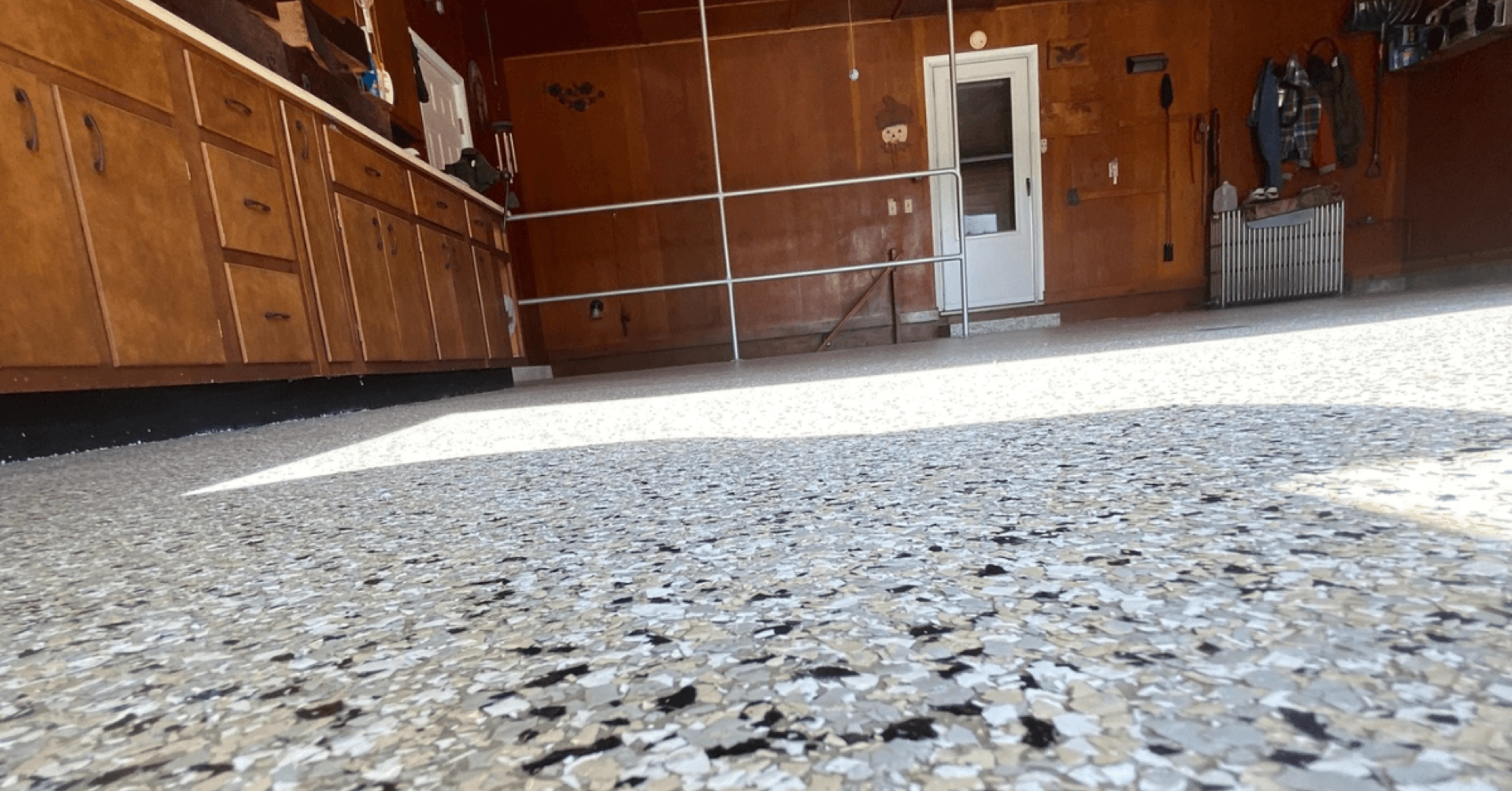
A coating turns the whole basement floor into one sealed, finished surface. Sweat, chalk and spills wipe up instead of soaking in, the concrete stops shedding dust, and the room looks like part of the house instead of a basement with mats on it.
Every basement starts with a moisture test. Then the slab is diamond-ground and repaired, and a moisture-tolerant base coat, decorative flake and a UV-stable polyaspartic topcoat go down. Most basements are finished in a single day. Our basement and indoor floor coating service page explains the full system.
Why is the best setup usually both?
Because each one covers the other's weak spot. The coating seals the slab and finishes the room; the mats handle impact where you lift. Put mats or a platform in the lifting zone, leave the rest of the coated floor open for cardio, stretching and storage, and the whole room stays easy to clean.
A coating isn't a shock absorber. If you drop heavy weights, you need mats or a lifting platform on top, coated floor or not. The same idea works in the garage, and our comparison of garage floor mats vs. a polyaspartic coating explains it from that side.
How do the costs compare?
Mats cost less up front, and you can start with a few and add more. A polyaspartic coating is a bigger one-time investment, at $7–$10 per square foot installed, but it finishes the whole room, not just the lifting area, and it carries a 15-year written, transferable warranty covering peeling, delamination and material failure. Your exact price depends on the size and condition of the slab and comes as a flat-rate quote at a free on-site estimate.
We coat basements across Greater Cleveland, from Cleveland to Summit and Medina counties.
When isn't a coating the right answer?
If the moisture test shows more than a coating can handle, or if water is actually coming into the basement, that has to be dealt with first. We'll tell you straight and recommend what to look into before any coating goes down.
Once your floor is coated, keeping it clean is easy. Our guide to cleaning and maintaining a polyaspartic floor covers the routine.
Frequently Asked Questions
Can you put rubber gym mats on a coated basement floor?
Yes, and it's the setup we'd recommend for most home gyms. The mats handle impact in the lifting area, and the coating seals and finishes the rest of the floor.
Do rubber mats trap moisture on a basement floor?
On bare concrete they can, because moisture coming up through the slab has nowhere to go. A sealed floor underneath keeps that moisture out of the space between the slab and the mats.
Can a coated floor handle dropped weights?
A coating isn't a shock absorber. Use rubber mats or a lifting platform wherever weights get dropped, on any floor.
Is a coated basement floor slippery with sweat?
Any smooth floor gets slicker when it's wet. The flake broadcast adds texture, and we can go over slip-resistance options for the topcoat during your free estimate.
Do you test basement floors for moisture?
Yes. Every basement is moisture-tested before we coat it. If the readings are too high, we'll recommend dealing with that first.
How long does a basement coating take?
Most basements are finished in a single day, and light foot traffic is fine within hours.
Plan Your Basement Gym Floor
Book a free on-site estimate for your basement gym — call 440-821-7220.