
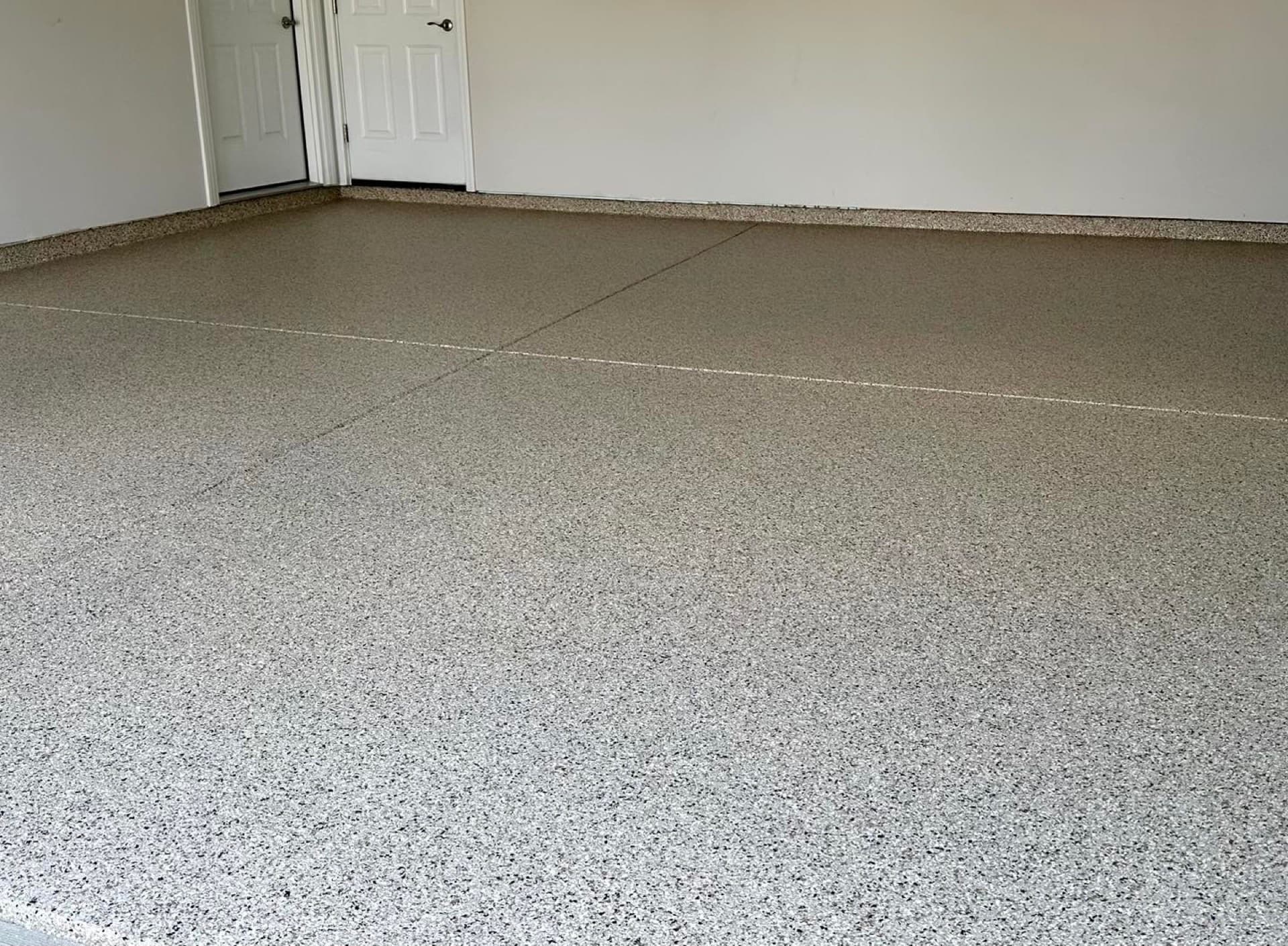
Garage floor mats catch slush; a polyaspartic coating protects the concrete itself. A containment mat or roll-out mat is a cheap, removable way to keep meltwater off part of the floor, but salty water still reaches the bare slab around it and can collect under it. A polyaspartic coating seals the entire floor so salt, oil and water sit on top of the concrete instead of soaking in. It costs $7–$10 per square foot installed and carries a 15-year warranty. For many Ohio garages, the best answer is a coated floor with a containment mat on top.
Every fall, homeowners from Parma to Akron stand in the garage and ask the same question: is it worth coating the floor, or should I just put down mats before the salt trucks come out? This guide compares the common mat types with a polyaspartic coating on what matters in an Ohio winter — salt, moisture, cost over time, and how the floor looks in March.
What does an Ohio winter do to a garage floor?
Salt is the main problem. Rock salt and calcium chloride brine come off the roads on your tires, melt into puddles in the garage and soak into bare concrete. As the water dries, salt crystals form inside the concrete's pores and break the surface apart from the inside. Calcium chloride also pulls moisture out of the air, so the slab stays damp long after the snow is gone.
Freeze-thaw makes it worse. An unheated garage can swing above and below freezing many times in a single month, and water that has soaked into the concrete expands every time it freezes. The result is the pitting, scaling and white crust you see near the garage door each spring. Our guide to repairing a salt-damaged garage floor shows what that damage looks like up close.
So any solution has to do one job: keep salty water from sitting in the concrete. That is the yardstick for everything below.
What kinds of garage floor mats are there?
Mats fall into four broad groups, and each handles water differently:
- ✓Containment mats — a flat mat with a raised edge that sits under one car and holds meltwater like a shallow tray until it evaporates or you squeegee it out.
- ✓Roll-out vinyl or rubber mats — sheets that roll out across part or all of the floor and give it a finished look.
- ✓Interlocking tiles — snap-together plastic tiles that cover the whole floor. Some are solid; others are vented so water drains through to the concrete.
- ✓Absorbent mats — carpet-style or fabric mats that soak up drips and oil.
Prices vary a lot by type, brand and thickness, but every one of these costs far less up front than a professional coating. That low entry cost is the main reason people reach for a mat first.
Where do mats fall short in an Ohio garage?
Mats protect what they cover, and only while the water stays on top of them. That's the catch.
A containment mat holds slush under the car, but it does not cover the whole floor. Salty water still gets tracked onto the bare concrete around it, drips off the edges when you drag the mat out to empty it, and puddles by the door where you walk in. The mat protects the middle of one parking space. The damage shows up everywhere else.
Full-floor mats and tiles have the opposite problem. Water works its way through the seams, vents and edges and then sits trapped between the mat and the slab, where it cannot evaporate. Concrete that stays wet and salty under a mat all winter can end up in worse shape than concrete left bare, and you will not see it until you pull the mat up in spring.
Absorbent mats help with oil drips, but once they are saturated with salty meltwater they are just a wet layer sitting on your concrete.
None of that makes mats useless. It means a mat is a slush catcher, not floor protection.
What does a polyaspartic coating do differently?
A polyaspartic coating changes the floor itself. The concrete is diamond-ground, cracks and pits are repaired, and then a moisture-tolerant base coat, decorative flake and a UV-stable polyaspartic topcoat go down over the entire slab, wall to wall. Salty water, oil and road grime sit on top of a sealed surface instead of soaking into the concrete, so there is nothing for salt crystals to break apart from the inside.
Because the coating is part of the floor, there are no seams for water to get under and nothing to pull up and dry out in spring. Cleanup is a squeegee and a rinse. And unlike epoxy, polyaspartic stays flexible through freeze-thaw and doesn't yellow under sunlight from an open garage door. Our garage floor coating service page covers the full system.
How do mats and a coating compare on cost?
Mats win on up-front cost. A containment mat is the cheapest thing you can do this weekend, and even full-floor mats or tiles cost much less to buy than a professional coating. But mats protect only what they cover, wear out over time, and do nothing about damage that is already in the slab.
A polyaspartic coating is a bigger one-time investment, at $7–$10 per square foot installed. That price includes diamond grinding and crack and pit repair, so the coating fixes the damage already in the slab as well as protecting the floor from here on, and it carries a 15-year written, transferable warranty. Your exact price depends on the size of your garage and the condition of the slab, and you get it as a flat-rate quote at a free on-site estimate. Our polyaspartic garage floor cost guide explains what moves a quote.
When does a mat make sense?
Honestly, sometimes a mat is the right call. If you rent your home, plan to move within a year or two, or need something before the first snow while you save for a coating, a containment mat is a sensible stopgap. It keeps the worst of the slush off the floor for very little money.
Mats also make sense on top of a coated floor. A containment mat under each car catches the bulk of the meltwater through the January–March stretch, so you're squeegeeing less often, and the coating protects everything the mat doesn't. For anyone parking two salty cars in the garage every day, that combination is what we'd recommend.
What we don't recommend is covering a bare, already-pitted slab with full-floor mats and calling it fixed. That just hides the damage while it keeps getting worse.
How do you keep a coated garage floor clean through winter?
A few simple habits keep a coated floor looking good until spring:
- ✓Squeegee standing slush toward the door or a floor drain after big snow days.
- ✓Rinse the floor with plain water a few times a winter to wash off dried salt film.
- ✓Keep a containment mat under each car if you park in the garage every day.
- ✓Clean with a neutral-pH cleaner, and skip harsh solvents and acidic cleaners.
If you are still choosing a color, some blends hide salt film and tire marks far better than others. Our guide to the best garage floor colors for hiding salt, dirt and tire marks covers which ones work.
Frequently Asked Questions
Do garage floor mats protect concrete from salt?
Only the part they cover, and only while water stays on top of the mat. Salty water still reaches the bare concrete around the mat, and full-floor mats can trap it underneath. A mat reduces the mess; it does not seal the slab.
Can you put mats on a polyaspartic-coated floor?
Yes, and it is a good combination. The mat catches most of the slush under the car, and the coating protects the rest of the floor. Empty the mat as needed and rinse the floor under it now and then.
Are interlocking garage tiles better than a coating?
They cover the whole floor and look clean, but water can get through the seams and sit on the concrete underneath, where you cannot see it. A coating seals the slab itself, so there is nothing for water to collect under.
Is a polyaspartic floor slippery when wet?
Any smooth floor gets slicker when it is wet. The flake broadcast adds texture, and we can go over slip-resistance options for your topcoat during the estimate.
Will a coating fix salt damage that is already there?
In most cases, yes. Diamond grinding removes the damaged surface, and the repair step fills pits and cracks before any coating goes down. Mats cannot do that. If the slab has structural damage, we will tell you on the estimate.
How long does a polyaspartic garage floor take to install?
Most garages are done in one day. Light foot traffic is fine that evening, and you can drive on the floor the next morning.
Get a Free Garage Floor Estimate
Want a real number on your floor before winter? Call 440-821-7220 for a free on-site estimate.