
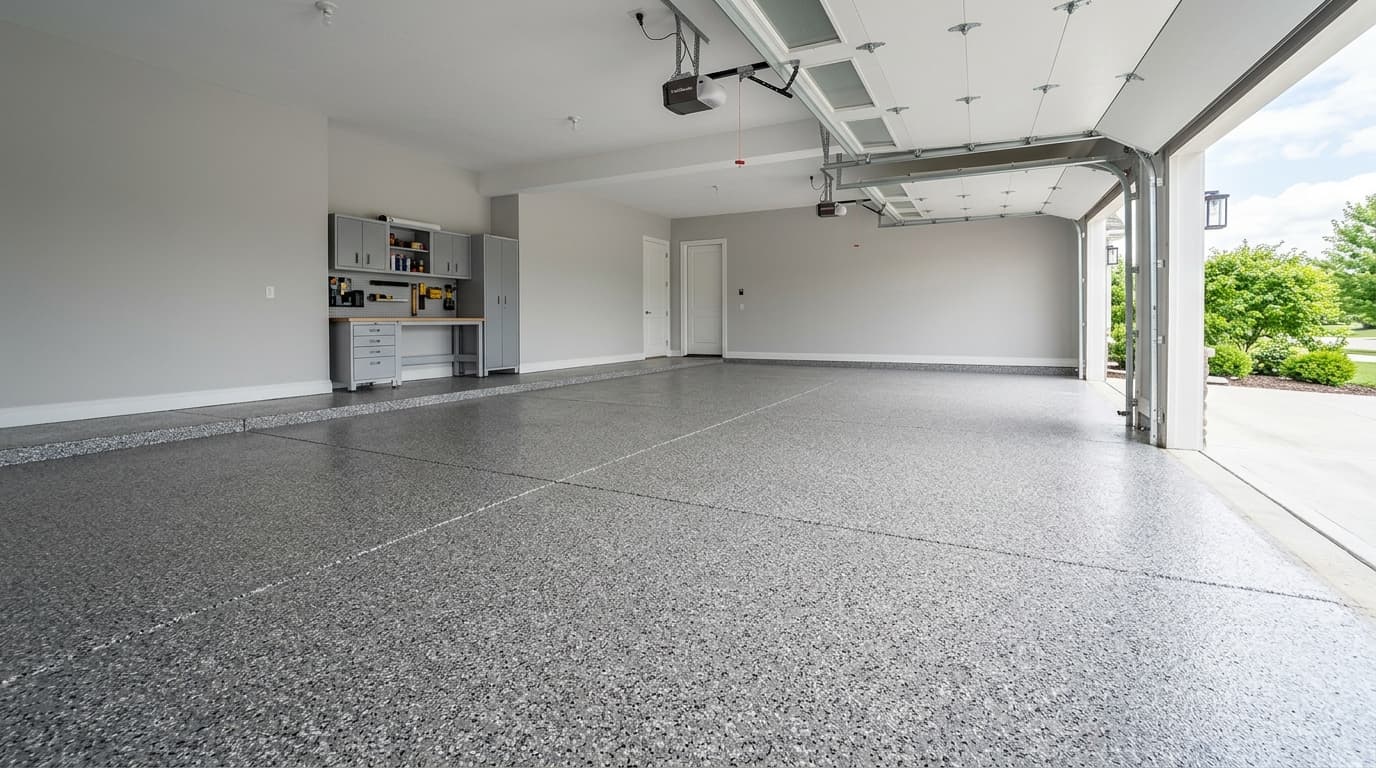
A polyaspartic garage floor in Northeast Ohio costs $7–$10 per square foot installed in 2026. At that rate, a 400–576 sq ft two-car garage runs $2,800–$5,800, a 600–800 sq ft three-car garage runs $4,200–$8,000, and a 900–1,200 sq ft four-car or RV garage runs $6,300–$12,000. The price includes diamond grinding, crack repair, the polyurea base coat, decorative flake, the polyaspartic topcoat, and a non-prorated, transferable 15-year warranty.
Every dollar figure in this guide has the square footage printed next to it, because a cost guide you can't check the math on isn't a cost guide — it's an advertisement. Multiply the square footage by $7 and by $10 and you will land on the same bands we publish. What follows is what those dollars buy, what pushes a quote toward $10 instead of $7, and what a quote under $7 per square foot in this market usually means.
What's included in a $7–$10 per square foot polyaspartic garage floor?
A polyaspartic garage floor at $7–$10 per square foot is a full multi-layer system, not a single product rolled onto bare concrete. Diamond Concrete Coating quotes that range as one flat-rate number covering every step below — prep, materials, labor, cleanup, and the 15-year warranty. Nothing on this list is an add-on, an upgrade tier, or a line item that appears on install day.
- ✓Diamond grinding — industrial diamond grinders profile the slab, strip old sealer, paint, or failed coating, and open the concrete for a mechanical bond. No acid etching.
- ✓Crack, joint, and pit repair — every hairline crack, control joint, and salt pit is filled and leveled before any coating goes down.
- ✓Polyurea base coat — a flexible, moisture-tolerant polyurea base goes down across the full slab. This is the layer doing the structural work.
- ✓Decorative flake broadcast or solid color — full flake broadcast from our standard palette, or a solid satin color, at no difference in price.
- ✓Slip-resistant additive — included in the topcoat at no extra charge on any floor that needs it. Some coating companies in this market bill this by the square foot.
- ✓UV-stable polyaspartic topcoat — the topcoat seals the flake in, locks out salt and moisture, and stays color-stable under sunlight from an open garage door.
- ✓Cleanup, reset, and the 15-year warranty — non-prorated and transferable, included in the quoted price.
What that price does not cover: anything structural. Slab replacement, foundation work, waterproofing, and drainage are outside a coating system, and Diamond flags them at the estimate rather than coating over them. The full system breakdown lives on our garage floor coating service page.
How much does a 2-car garage floor cost in Ohio?
A two-car garage floor coating in Ohio costs $2,800–$5,800 installed. A standard two-car garage measures 400–576 sq ft, so at $7–$10 per square foot the band runs from 400 × $7 = $2,800 at the small and simple end to 576 × $10 = $5,760 at the large and complicated end. Most Northeast Ohio two-car garages measure 450–500 sq ft, which lands at $3,200–$5,000.
The spread inside that band is wider than homeowners expect, and it is almost entirely about the slab rather than the size. A 1990s-build two-car garage in Strongsville with a clean, dry, uncoated slab sits near the bottom. A 1950s two-car with two decades of untreated road salt, a failed DIY epoxy that has to be ground off in full, and a dozen linear feet of cracking sits near the top of the same band for the same square footage.
How much does a 2.5-car garage floor cost?
A 2.5-car garage floor coating costs $3,500–$6,500 installed. A 2.5-car garage — two bays plus a workbench or storage bump-out — typically measures 500–650 sq ft, which at $7–$10 per square foot gives 500 × $7 = $3,500 at the low end and 650 × $10 = $6,500 at the high end.
The 2.5-car garage is the size where layout starts to matter as much as square footage. A rectangular 550 sq ft bay is a fast install. The same 550 sq ft split around a support post, a step-down to a side door, and a built-in shelving run takes more masking and more careful flake broadcast at the edges, which moves the quote up within the band.
How much does a 3-car garage floor cost?
A three-car garage floor coating costs $4,200–$8,000 installed. A three-car garage measures 600–800 sq ft in most Northeast Ohio builds, so the arithmetic runs 600 × $7 = $4,200 to 800 × $10 = $8,000. A common 700 sq ft three-car lands at $4,900–$7,000.
Three-car garages tend to price closer to the middle of their band than two-car garages do, for a simple reason: the fixed costs of an install — mobilization, grinder setup, masking, mixing, and crew time on site — spread across more square footage. That is why per-square-foot pricing on a large garage drifts toward $7 while a small one-car bay drifts toward $10.
How much does a 4-car or RV garage floor cost?
A four-car or RV garage floor coating costs $6,300–$12,000 installed. Four-car and RV bays run 900–1,200 sq ft, which at $7–$10 per square foot gives 900 × $7 = $6,300 through 1,200 × $10 = $12,000. A 1,000 sq ft detached shop or RV bay lands at $7,000–$10,000.
Two things specific to this size are worth budgeting for. RV bays and detached shops often have heavier slab damage than an attached garage, because they store equipment, take dripping vehicles, and rarely get swept. And a floor over roughly 1,200 sq ft can push past a single-day install window — which is a scheduling question, not a price question. Our walkthrough of what a one-day garage floor coating actually involves covers where that line sits.
Polyaspartic garage floor cost by size — the full table
Here is every garage size at $7–$10 per square foot, with the square footage beside it so the arithmetic is checkable. These are the same bands Diamond Concrete Coating quotes across Cuyahoga, Medina, and Summit counties — the rate does not change by suburb.
- ✓1-car garage — 200–288 sq ft — $1,400–$2,900 installed
- ✓2-car garage — 400–576 sq ft — $2,800–$5,800 installed (typical 450–500 sq ft: $3,200–$5,000)
- ✓2.5-car garage — 500–650 sq ft — $3,500–$6,500 installed
- ✓3-car garage — 600–800 sq ft — $4,200–$8,000 installed
- ✓4-car or RV garage — 900–1,200 sq ft — $6,300–$12,000 installed
- ✓Detached shop or oversized bay — 1,000 sq ft — $7,000–$10,000 installed
Measure your own garage before your estimate and you can price it yourself: length × width, then multiply by $7 and by $10. Whatever number a contractor gives you should sit inside that window, and if it doesn't, the right response is to ask which part of the system is different.
What drives a polyaspartic garage floor quote up?
Four variables move a polyaspartic garage floor quote inside the $7–$10 range, and none of them are the color you pick. Prep is where the money goes. A garage floor coating is roughly half preparation labor by cost, which is why two garages of identical square footage can quote $1,500 apart.
Existing coating removal
Removing a failed coating is the single most common reason a garage floor quote moves toward $10 per square foot. A previously applied epoxy, a big-box roll-on kit, a concrete stain, or a decades-old sealer all have to come off completely before a polyurea base coat can bond, and that means slower grinding passes and more diamond tooling wear.
Good news for the budget: diamond grinding removes the old coating and profiles the fresh concrete in the same operation, so removal rarely adds a separate day. If you're specifically replacing a failed epoxy floor, our guide to replacing an epoxy garage floor with polyaspartic covers what that transition looks like.
Concrete condition and crack repair
Slab condition is the second driver. Surface scaling, hairline cracking, salt pitting near the garage door, and worn control joints are all normal in Northeast Ohio and are already priced inside the $7–$10 range on a structurally sound slab. Extensive deep pitting from a decade of untreated deicer exposure, or a slab with heavy spalling across the front lip, takes more repair material and more grinding time and pushes toward the top of the band.
What takes a garage off the table entirely is structural: a slab that has settled or heaved more than about a half inch across a joint, or one sitting on a failed sub-base. A coating follows the slab it is bonded to. If the slab has moved, the honest answer is slab work first, coating second — and we will tell you that at the estimate rather than after.
Moisture in the slab
Slab moisture is the driver most homeowners have never heard of and the one most likely to change a project. Moisture vapor pushing up through a garage slab will blister and delaminate a coating from underneath within months, no matter how good the topcoat is. The industry threshold is 3 lbs per 1,000 sq ft per 24 hours, measured with an ASTM calcium chloride test that itself has to sit in place for 60–72 hours.
When a slab fails that test, the fix is a moisture-mitigating primer before the base coat — real added cost, and a second visit. Diamond quotes mitigation separately and honestly rather than burying it in the headline number, and reschedules rather than coating a wet slab and hoping. A contractor who never mentions slab moisture on a Northeast Ohio garage is not doing you a favor.
Accessibility, layout, and size
Layout and access make up the last few percent. A clean rectangular bay with a wide door and a level driveway is the fastest install there is. A garage with a support post, a step-down landing, built-in cabinetry that has to be masked, a floor drain, or a tight approach that keeps the grinder farther from the truck all add labor without adding square footage.
Size cuts the other way. Because setup, masking, and mobilization are fixed costs, larger garages carry a lower per-square-foot rate. That is the entire reason a 250 sq ft one-car bay prices near $10 per square foot while a 1,000 sq ft shop prices near $7.
Why are some Cleveland-area garage floor quotes $4 or $5 per square foot?
A garage floor quote well under $7 per square foot in the Cleveland market almost always means one of four things, and it is worth knowing which one before you sign. Cheaper quotes are not automatically dishonest — but they are almost never the same system at a lower price.
- ✓A thinner system — a single-coat hybrid or a heavily thinned product instead of a full polyurea base plus a separate polyaspartic topcoat.
- ✓Lighter prep — acid etching or a light buff instead of full diamond grinding. Prep is the most expensive part of the job and the easiest place to cut without a homeowner noticing until year three.
- ✓An add-on-later price — the headline number covers a basic install, and crack repair, moisture mitigation, premium flake, and warranty upgrades appear as separate line items at signing or on install day.
- ✓A subcontracted crew — the company that sold you the job is not the company standing in your garage, and the warranty is only as good as whoever is still answering the phone in year 12.
The fastest way to test any quote is to ask for the system in writing: base coat chemistry, topcoat chemistry, prep method, mil thickness, and the exact warranty language. Our buyer's guide to comparing garage floor coatings and installers for Ohio winters has the full list of questions to ask.
How does polyaspartic cost compare to epoxy, paint, and DIY kits over 15 years?
A polyaspartic garage floor costs more upfront than every alternative and less than all of them over 15 years. That is the whole argument, and it only works if you look at the full window instead of the install invoice. Here is the honest 15-year math on a 500 sq ft two-car garage in Northeast Ohio.
- ✓Polyurea base + polyaspartic topcoat — $7–$10 per sq ft installed ($3,500–$5,000 on 500 sq ft). Expected service life 15+ years. One install, non-prorated transferable 15-year warranty, no recurring maintenance cost.
- ✓Professionally installed epoxy — $3–$5 per sq ft installed ($1,500–$2,500 on 500 sq ft). Expected service life 2–5 years in an Ohio garage before yellowing, hot-tire pickup, or peeling at the door lip. Two to three reinstalls inside 15 years, plus removal grinding each time.
- ✓Concrete paint or sealer — $1–$2 per sq ft ($500–$1,000 on 500 sq ft). Service life 1–3 Ohio winters. Offers effectively no protection against calcium chloride deicers.
- ✓DIY hardware-store kit — $250–$600 in materials plus a weekend. Thin, acid-etch prep, no moisture testing. Most fail at the garage door lip in the first or second winter and have to be ground off before a real system can go down.
Run the 15-year total on a 500 sq ft garage and the polyaspartic system comes out ahead of every alternative except doing nothing. The full lifecycle breakdown, including cure chemistry and freeze-thaw performance, is in our polyaspartic vs. epoxy cost comparison for Ohio winters.
Why does Diamond quote flat-rate instead of by the hour?
Diamond Concrete Coating quotes a single flat-rate number for the whole garage because an hourly quote transfers every risk in the job to the homeowner. If the grinding takes an extra two hours because a previous owner rolled on an epoxy kit in 2011, that is our estimating problem, not your invoice problem.
The estimate is on-site, free, and takes about 20 minutes. We measure the slab, check it for moisture and salt damage, look at the joints and the door lip, and hand you a flat number the same visit. That number covers grinding, repair, base coat, flake, topcoat, cleanup, and the warranty. Nothing gets added on install day.
We're family-owned and we don't subcontract. The crew that grinds your slab in Cleveland or Strongsville is our own crew with our own equipment, and the name on the truck is the name on the warranty.
Is the 15-year warranty really included in the price?
Yes — Diamond's 15-year warranty is included in the $7–$10 per square foot price at no additional cost, and it is both non-prorated and transferable. Non-prorated means coverage in year 14 is the same coverage as in year one, with no annual decay schedule quietly reducing what we owe you. Transferable means it moves to the next owner if you sell the house.
That structure matters more than warranty length, and it is where a lot of coating warranties in this market quietly fall apart. A 'lifetime' warranty that prorates down by half in five years and voids on sale is worth less in practice than a defined term that doesn't. Ask any contractor you're comparing for the actual warranty document — not the brochure line — and read what happens in year ten and what happens when the house changes hands.
Get the real number for your garage — free flat-rate estimate
If you want the actual number for your actual garage instead of a range, Diamond Concrete Coating gives free on-site estimates across Greater Cleveland, Akron, and Medina County — measured, checked for moisture, and priced flat-rate on the same visit. Call 440-821-7220 or book online, and most estimates happen within 48 hours of the call.
Fall is the strongest install window of the year in Northeast Ohio: falling humidity, stable slab temperatures, and a finished garage floor cured well before the first load of road salt comes home on your tires.
Frequently Asked Questions
Can you give me a polyaspartic garage floor price over the phone?
We can give you a ballpark over the phone from your garage dimensions — length × width × $7–$10 gets you close. A firm, flat-rate number requires an on-site measurement, because the two things that move a polyaspartic garage floor quote most are slab condition and slab moisture, and neither is visible over the phone. The on-site estimate is free and takes about 20 minutes.
Do you offer financing on a garage floor coating?
Yes. Diamond Concrete Coating offers financing on residential garage and patio projects through our standard payment partner. Most homeowners use it to spread a $3,200–$5,000 two-car garage floor over 12–24 months. Ask during your estimate and we'll walk through the options and the terms before you commit to anything.
Is a bigger garage cheaper per square foot to coat?
Yes. The per-square-foot rate on a polyaspartic garage floor drops as the garage gets bigger, because mobilization, masking, grinder setup, and mixing are fixed costs spread across the whole floor. A 200–288 sq ft one-car bay prices near $10 per square foot; a 900–1,200 sq ft four-car or RV garage prices closer to $7. The total goes up with size — the rate goes down.
What's not included in a polyaspartic garage floor quote?
Anything structural sits outside a polyaspartic garage floor quote: slab replacement, foundation repair, slab lifting, waterproofing, and drainage work. Moisture mitigation is quoted separately when a slab fails the calcium chloride test, because it is real added material and a second visit. Everything else — diamond grinding, crack and pit repair, polyurea base, flake, polyaspartic topcoat, slip-resistant additive, cleanup, and the 15-year warranty — is inside the flat-rate number.
Is the 15-year warranty prorated or transferable?
Diamond's 15-year warranty is non-prorated and transferable. Coverage in year 14 is identical to coverage in year one — there is no annual decay schedule — and the warranty transfers to the next homeowner if you sell. It covers peeling, delamination, and material failure of the coating system, and it is included in the $7–$10 per square foot price rather than sold as an upgrade.
Do you charge for garage floor estimates in Northeast Ohio?
No. Every Diamond Concrete Coating estimate is free, on-site, and no-pressure, anywhere in our Greater Cleveland, Akron, and Medina County service area. We measure the slab, test what needs testing, point out salt damage or moisture issues you may not have noticed, and give you a flat-rate price the same visit. Call 440-821-7220 to get on the schedule.