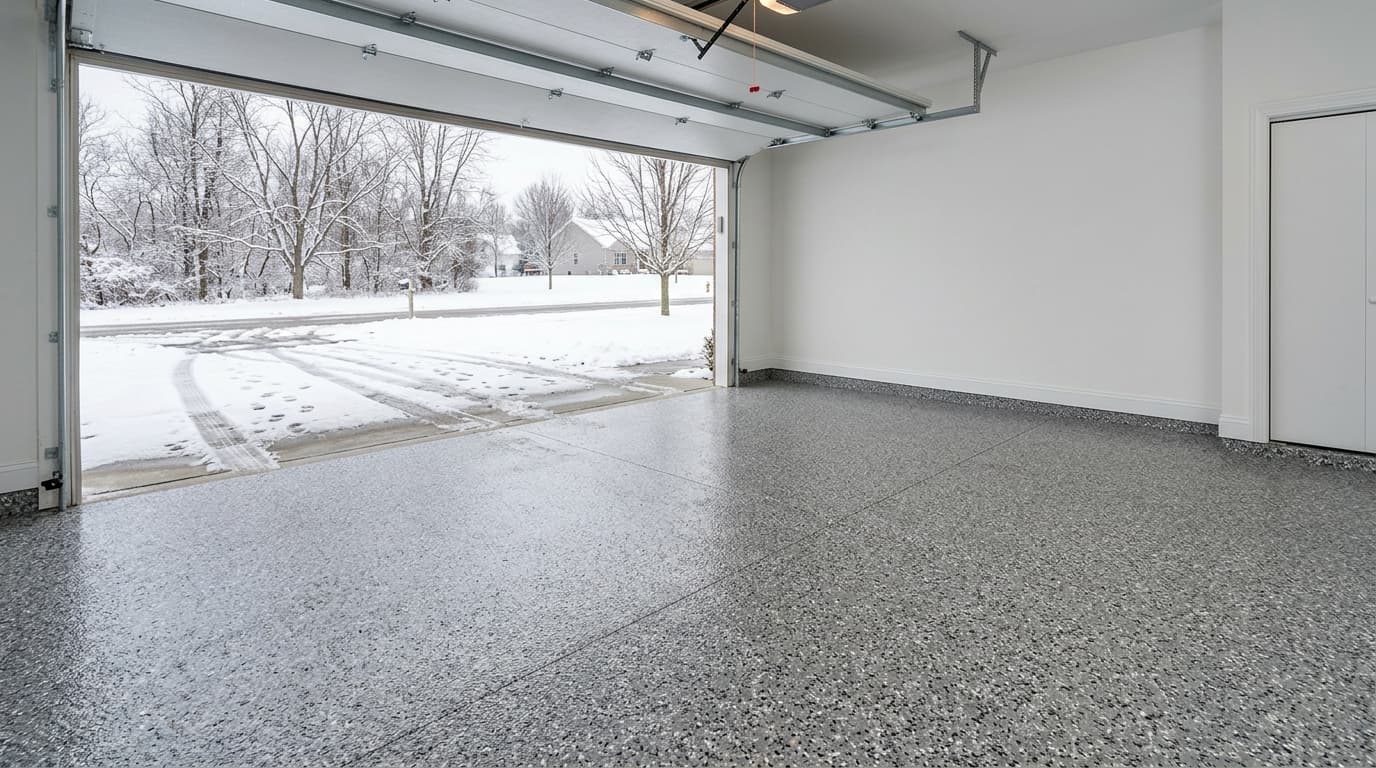
The best garage floor coating for Ohio winters in 2026 is a two-part polyurea base coat under a UV-stable polyaspartic topcoat. It flexes through freeze-thaw instead of cracking, resists calcium chloride road salt, and installs in cold-season conditions that shut epoxy down. But the system is only half the decision — in Northeast Ohio, the installer and the warranty structure determine whether that floor is still intact in year twelve.
This guide is about the second half. If you want the chemistry-level, side-by-side breakdown of polyaspartic against epoxy — cure temperatures, mil thickness, 15-year lifecycle cost — that is covered in depth in our polyaspartic vs. epoxy comparison for Ohio winters. What follows here is how to shop: which options are genuinely on the table, how to compare the companies quoting them, and the specific questions that separate a floor that lasts from a floor that peels.
What makes a garage floor coating "good" for an Ohio winter?
A garage floor coating survives an Ohio winter on five properties, and a system that fails any one of them will fail the floor. Northeast Ohio garages take over a hundred freeze-thaw cycles a year, constant calcium chloride tracked in on tires from November through March, standing snowmelt under parked vehicles, and UV exposure every time the door goes up.
- ✓Flexibility through freeze-thaw — the coating has to move with the slab as it expands and contracts, not crack with it.
- ✓Chemical resistance to deicers — calcium chloride and brine are the most aggressive things that will ever touch your garage floor.
- ✓Moisture tolerance — an Ohio slab pushes vapor upward year-round, and a coating that cannot tolerate it delaminates from underneath.
- ✓UV stability — sunlight through an open garage door yellows and embrittles non-UV-stable resins, which is a topcoat property, not a color choice.
- ✓Cold-season installability — a system you can only install in July is a system you wait nine months for.
Which garage floor coating options are actually on the table in Ohio?
Five categories of garage floor coating get quoted in Northeast Ohio, and only one of them is engineered for the whole list above. Here is the honest survey, including what each option is genuinely good at.
Polyurea base with a polyaspartic topcoat
A polyurea base coat under a polyaspartic topcoat is the system built for this climate. Polyurea is flexible and moisture-tolerant and does the structural work at the slab; the polyaspartic topcoat is UV-stable, chemically resistant, and takes the abrasion. The two chemistries also recoat within one to two hours of each other, which is what makes a same-day install possible.
Cost in this market is $7–$10 per square foot installed, with a service life of 15+ years. It is the most expensive option upfront and the cheapest one across fifteen years. Full per-size numbers are in our 2026 polyaspartic garage floor cost guide.
Epoxy
Epoxy is a rigid, high-build resin that bonds well to properly prepared concrete and is genuinely excellent in a climate-controlled interior. In an unheated Ohio garage it has three structural problems: it is rigid where the slab needs the coating to flex, it is not UV-stable so it ambers and embrittles under door-opening sunlight, and it generally will not cure below roughly 50°F — which is why most epoxy installers in this market stop taking garage work in November.
Professionally installed epoxy runs $3–$5 per square foot in Northeast Ohio with a realistic 2–5 year service life in a garage. If you already have an epoxy floor that's failing, our guide to replacing an epoxy garage floor with polyaspartic covers the transition.
Concrete paint and sealers
Concrete paint and topical sealers cost $1–$2 per square foot and last one to three Ohio winters. They are a cosmetic refresh, not a protective system — they do not stop calcium chloride from reaching the concrete, and they peel at the garage door lip where snowmelt sits. Paint is a reasonable choice only if you are selling the house in spring and want the floor to photograph well.
DIY hardware-store kits
A DIY hardware-store garage floor kit costs $250–$600 and takes a weekend. The failure point is not the resin, it is the prep: kits specify acid etching rather than diamond grinding, include no moisture testing, and go down far thinner than a professional system. In an Ohio garage most fail at the door lip in the first or second winter, and the failed coating then has to be ground off before a real system can be installed — so the kit costs you twice.
"Ceramic," "hybrid," and other marketing names
"Ceramic garage floor coating," "hybrid polymer," and similar names are marketing labels, not distinct chemistries — in practice they usually describe a polyurea or polyaspartic variant, sometimes a thinned one. The label tells you nothing. The fix is simple and it works on any contractor: ask for the product data sheet for the base coat and the topcoat by name, and ask for the applied mil thickness. A company installing a real system will hand both over without hesitating.
Garage floor coating options compared at a glance
Here is how the realistic options compare on the five properties that decide an Ohio garage floor, with 2026 Northeast Ohio installed pricing.
- ✓Polyurea base + polyaspartic topcoat — Flexes through freeze-thaw: yes · Deicer resistant: yes · Moisture tolerant: yes · UV stable: yes · Cold-season install: yes · $7–$10/sq ft · 15+ year life · 15-year non-prorated transferable warranty
- ✓Professional epoxy — Flexes through freeze-thaw: no, rigid · Deicer resistant: moderate · Moisture tolerant: no · UV stable: no, ambers · Cold-season install: no, generally will not cure below ~50°F · $3–$5/sq ft · 2–5 year life in a garage
- ✓Concrete paint or sealer — Flexes: no · Deicer resistant: no · Moisture tolerant: no · UV stable: varies · Cold-season install: no · $1–$2/sq ft · 1–3 winters
- ✓DIY hardware-store kit — Flexes: no · Deicer resistant: minimal · Moisture tolerant: no, no moisture testing included · UV stable: no · Cold-season install: no · $250–$600 per kit · Typically fails in winter 1–2 at the door lip
How should I compare garage floor coating installers in Ohio?
Compare Ohio garage floor coating installers on four things, in this order: the structure of the warranty, the size of the crew assigned to your job, the prep method, and whether the company that sells the job is the company that installs it. Product brand belongs near the bottom of that list — most reputable installers in Northeast Ohio use comparable industrial-grade material, and the difference between a floor that lasts and one that peels is almost always prep and workmanship.
Warranty structure beats warranty length — every time
Read the warranty structure before you read the warranty number. A garage floor coating warranty has three variables that matter far more than the headline term: whether it is prorated, whether it is transferable, and what specifically it covers. A "lifetime" warranty that prorates is worth a fraction of its advertised value — coverage decays on a schedule, often to roughly half by year five and to very little by year ten — and many are non-transferable, so the coverage evaporates the day you sell the house.
Diamond Concrete Coating's warranty is 15 years, non-prorated, and transferable. Non-prorated means the coverage in year 14 is the same coverage as in year one, with no decay schedule. Transferable means it moves to the next owner with the house. That is a deliberately narrower promise than "lifetime" and a materially larger one in practice.
So do not compare 15 against lifetime. Compare the documents. Ask every contractor for the actual warranty text and find three answers in it: does coverage reduce over time, does it survive a sale, and does it cover peeling, delamination, and material failure or only manufacturing defects in the resin. A contractor who won't put that in front of you before you sign has told you what you need to know.
How many installers will be on my crew?
Ask how many installers will be in your garage and whether your garage is the crew's only job that day. This is the single most useful question a homeowner can ask, and almost nobody asks it. Mixed polyaspartic has a working pot life as short as 10–20 minutes — once it's mixed, it has to go down and get flaked before it sets, which is physically impossible for one person spreading a two-car garage while driving to another job.
A properly staffed residential install is two to three installers dedicated to one site for the day. The most common one-day install failure story is not a chemistry failure — it is a homeowner who was promised a day, got one worker, and lost the garage for two and a half days. Ask the question, get the answer in writing on the contract, and the risk mostly disappears.
Diamond grinding versus acid etching
Ask which prep method the contractor uses, and treat acid etching as a disqualifier for an Ohio garage. Mechanical diamond grinding profiles the concrete, removes old coatings and salt-contaminated surface material, and creates the surface profile a polyurea base coat needs to bond. Acid etching is faster and cheaper, leaves residue in the pores, and produces an inconsistent profile.
Prep is roughly half the labor cost of a garage floor coating, which makes it the easiest place to cut a quote without the homeowner noticing until the third winter. When a bid comes in dramatically under the $7–$10 per square foot market range, prep is usually where the difference went. Diamond Concrete Coating grinds every slab — never acid wash — as detailed on our garage floor coating service page.
Who actually shows up — own crew or subcontractors?
Ask whether the company installs with its own crew or subcontracts the work. A 15-year warranty is only as good as the company still answering the phone in year 12, and a subcontracted install adds a second question: which of the two companies owns the warranty when something goes wrong. Franchise operations in this market frequently sell with one team and install with another.
Diamond is family-owned, installs every job across Cleveland, Akron, and Medina County with its own crew and its own equipment, and does not subcontract. The name on the truck is the name on the warranty, and the number you call in year 12 is the same number you called for the estimate.
What are the red flags in a garage floor coating quote?
Six things in a garage floor coating quote should slow you down before you sign. None of them are automatically disqualifying on their own — but any two together in the same quote usually mean the system being sold is not the system being described.
- ✓A price well under the $7–$10 per square foot market range with no explanation of what is different about the system.
- ✓No mention of slab moisture testing anywhere in the quote or the conversation — on a Northeast Ohio garage, that is a real omission.
- ✓Acid etching, "chemical prep," or "surface cleaning" listed instead of mechanical diamond grinding.
- ✓A "lifetime" warranty with no written document offered, or one that turns out to be prorated, non-transferable, or limited to resin defects only.
- ✓Prep, crack repair, moisture mitigation, and slip-resistant additive priced as separate add-ons rather than included — the install-day upcharge pattern.
- ✓High-pressure discount timers: a price that is only good if you sign today is a sales tactic, not a price.
What should I demand in writing before I sign?
Get seven things in writing before you sign a garage floor coating contract in Ohio. All seven are reasonable requests and any competent installer can produce them on the spot — which is exactly what makes the list useful as a filter.
- ✓The base coat and topcoat named by product, with the manufacturer product data sheets attached.
- ✓The applied mil thickness of the finished system.
- ✓The prep method, stated as diamond grinding.
- ✓Crew size and the commitment that your garage is the crew's only job that day.
- ✓The full warranty document — with the prorated/non-prorated and transferable/non-transferable language visible, not summarized.
- ✓A flat-rate total with an explicit list of what is included, and explicit language that nothing is added on install day.
- ✓What happens if the slab fails a moisture test — reschedule and mitigate, or proceed anyway. The right answer is reschedule.
Can a garage floor be coated during an Ohio winter?
Yes — a polyurea and polyaspartic garage floor can be installed through an Ohio winter, and cold-season installability is one of the clearest practical advantages the system has. Epoxy generally will not cure below about 50°F, which is why many epoxy installers stop taking garage work in November. Polyurea and polyaspartic keep curing in cold conditions, so the install window runs year-round.
The real winter constraint is not the resin's temperature rating — it is the slab temperature and the dew point. A cold slab in a humid garage condenses moisture on its own surface, and moisture between the concrete and the base coat destroys adhesion no matter how cold-tolerant the resin is. That is why a competent installer measures slab temperature and dew point rather than glancing at the air temperature, and why the honest answer to "can you coat in February" is "yes, if the slab reads right that morning."
Practically, fall is still the best install window in Northeast Ohio: falling humidity, stable slab temperatures, and a floor fully cured before the first load of road salt arrives.
Our pick — and the honest disclosure
Diamond Concrete Coating installs exactly one system: a polyurea base coat with a UV-stable polyaspartic topcoat, diamond-ground prep, full flake broadcast, slip-resistant additive at no extra charge, and a 15-year non-prorated transferable warranty at $7–$10 per square foot. We do not install epoxy, and we do not install stamped, stained, or polished concrete. So yes — the system we recommend is the system we sell, and you should weigh this section accordingly.
What we would tell you even if you hire someone else: get the warranty document before you sign, confirm the crew size, confirm diamond grinding, and confirm somebody is testing the slab for moisture. Those four checks matter more than which company's logo ends up on the invoice, and they are the difference between a garage floor that is still flat and bonded in year 12 and one that starts lifting at the door lip in year three.
Get a Free Garage Floor Estimate Before Winter Booking Fills
If you're comparing garage floor coating quotes in Northeast Ohio and you want one that shows the whole system in writing — product data sheets, mil thickness, prep method, crew size, and the actual warranty document — call Diamond Concrete Coating at 440-821-7220 or book a free on-site estimate online.
We serve Greater Cleveland, Akron, Medina County, and the surrounding suburbs with the same flat-rate pricing and the same 15-year non-prorated, transferable warranty on every install. Most estimates are scheduled within 48 hours of the call.
Frequently Asked Questions
Can a polyaspartic garage floor be installed in winter in Ohio?
Yes. A polyurea and polyaspartic garage floor installs through an Ohio winter, unlike epoxy, which generally will not cure below about 50°F. The limiting factor in winter is slab temperature and dew point rather than air temperature — a cold slab in a humid garage can condense moisture on its own surface and ruin adhesion. A competent installer measures both on the morning of the install and reschedules if the slab doesn't read right.
What's the best brand of polyaspartic garage floor coating?
Brand matters less than installer quality for a polyaspartic garage floor. Most reputable Northeast Ohio installers use comparable industrial-grade polyurea and polyaspartic material, and the overwhelming majority of coating failures trace to preparation and workmanship, not to the resin. Instead of asking which brand, ask for the product data sheets for the base coat and topcoat, the applied mil thickness, the prep method, and the written warranty.
Is a DIY polyaspartic kit worth it for an Ohio garage?
For an Ohio garage, a DIY polyaspartic kit is usually a false economy. The kits are thinner than a professional system, specify acid etching rather than diamond grinding, and include no slab moisture testing — and moisture and prep are what actually cause coatings to fail here. Most fail at the garage door lip within one or two winters, and the failed coating then has to be ground off before a professional system can be installed.
How long should a garage floor coating last in Ohio?
A professionally installed polyurea and polyaspartic garage floor should last 15+ years in Ohio, which is why a 15-year warranty is a reasonable term to expect. Professionally installed epoxy realistically lasts 2–5 years in an unheated Ohio garage before ambering, hot-tire pickup, or peeling at the door lip. Concrete paint and sealers last one to three winters. DIY kits often fail in the first or second.
Does the color of a garage floor coating affect its durability?
No. Durability and UV stability in a garage floor coating live in the topcoat chemistry, not in the color or the flake blend you choose. A light tan flake floor and a charcoal flake floor with the same polyaspartic topcoat will wear, resist salt, and hold color identically. Color is a design decision, and at Diamond it does not change the price either — every standard palette color and blend sits inside the same $7–$10 per square foot range.
What is a "ceramic" garage floor coating?
"Ceramic" is a marketing term rather than a distinct coating chemistry. In practice, products sold as ceramic garage floor coatings are usually polyurea or polyaspartic variants, and sometimes thinned versions of them. The label tells a homeowner nothing useful. Ask the contractor for the manufacturer product data sheet naming the base coat and the topcoat, plus the applied mil thickness, and compare those instead of the marketing name.
How do I verify a garage floor installer's warranty claims?
Ask for the warranty document itself before signing, not the brochure summary, and read it for three things: whether coverage is prorated over time, whether it transfers to a new homeowner on sale, and whether it covers peeling, delamination, and material failure or only resin manufacturing defects. A "lifetime" warranty that prorates and doesn't transfer is worth less than a defined 15-year warranty that does neither. Diamond's 15-year warranty is non-prorated and transferable, and we hand the document over at the estimate.