
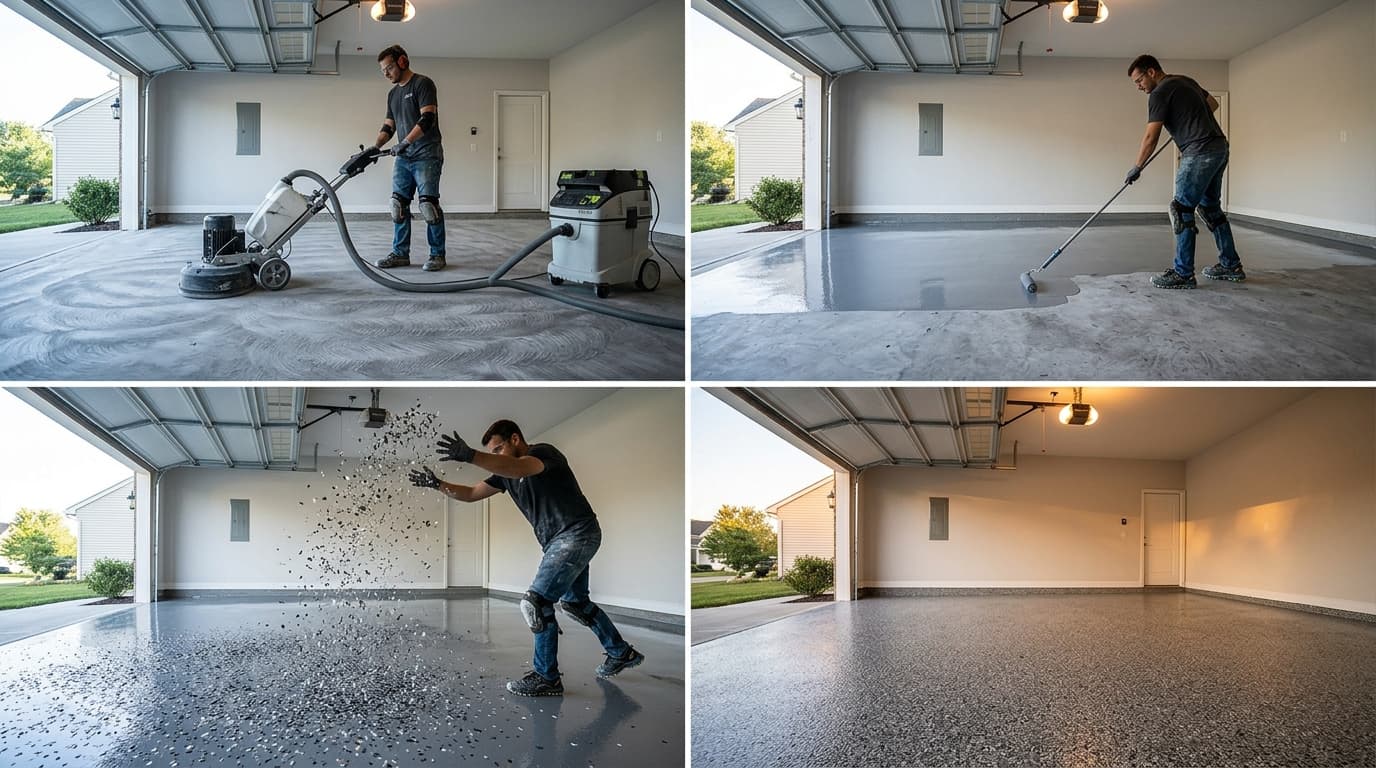
A one-day garage floor coating is real, not a marketing claim — a polyurea base coat and polyaspartic topcoat fit inside an 8–10 hour window because polyurea is engineered to be recoated in 1–2 hours rather than epoxy's 24–72. Your garage is cleared in the morning, ground by 9, base-coated and flaked by early afternoon, topcoated by late afternoon, walkable that evening, and driveable the next morning.
The fair question underneath that is whether a one-day install means somebody cut corners. It's a question some Northeast Ohio installers actively raise, and it deserves a straight answer rather than a slogan. This guide gives you the hour-by-hour reality of a one-day install, the chemistry that makes it possible, the question to ask that actually predicts whether your installer will finish on time, and the four conditions that legitimately push an install to another day.
What does a "one-day garage floor coating" actually mean?
A one-day garage floor coating means the entire installation — prep, grinding, repair, base coat, flake, and topcoat — is completed inside a single working day on site, typically 8–10 hours. It does not mean the floor is fully cured that evening. Light foot traffic is fine the same night; vehicles go back on the next morning; full chemical cure continues for several days after that.
Being precise about that distinction matters, because "one day" gets used loosely in this market. At Diamond Concrete Coating, one day means our crew arrives in the morning and the floor is finished when they leave that afternoon, with no second visit required. Roughly 95% of residential garages fit that window.
Doesn't a one-day install mean skipping cure time?
No — and this is the most important technical point in the whole conversation. The argument that a garage floor needs an overnight cure between coats is an argument about epoxy, whose slow cure is inherent to the resin chemistry. Epoxy genuinely needs 24–72 hours between coats. A two-day install built around an epoxy primer basecoat is not being careful; it is accommodating a limitation of the material it chose.
Diamond's base coat is polyurea, a different chemistry with a designed recoat window of 1–2 hours. Same-day recoat is the material's published specification, not a shortcut taken with it. Applying the polyaspartic topcoat inside that window is exactly how the manufacturer intends the system to go down — waiting overnight on a polyurea base coat wouldn't make the floor better, it would just mean a second day of your garage being unusable.
Where the criticism does land, and it lands hard, is prep. A one-day timeline is only legitimate if the grinding, crack repair, and moisture verification are done properly inside it. That is a staffing and scheduling question, not a chemistry question — and it's covered in the crew-size section below.
Hour by hour: what a one-day garage floor install looks like
Here is the actual sequence of a one-day polyurea and polyaspartic garage floor install on a typical 400–576 sq ft two-car garage in Northeast Ohio. Times shift with garage size and slab condition, but the order never changes.
7–9 AM — Move-out, masking, and diamond grinding
The crew arrives, moves your garage contents to the driveway, and masks walls, trim, the door track, and anything that isn't getting coated. Then industrial diamond grinders profile the entire slab — removing old sealer, paint, or a failed coating, and opening the concrete pores so the polyurea base coat can form a mechanical bond. Dust is captured at the grinder with HEPA vacuum extraction.
This is the loudest, dustiest, and most labor-intensive stretch of the day, and it's the part a cut-rate install shortens. Diamond grinds every slab — we never acid etch.
9–11 AM — Crack, joint, and pit repair
With the slab ground clean, every hairline crack, control joint, spall, and salt pit gets filled and leveled. On an older Northeast Ohio garage — the 1950s slabs common around Strongsville and the west-side suburbs — this is the step that decides whether the finished floor reads as flat and continuous or as a coated version of an old damaged slab.
Repairs need a short set before coating goes over them, which is why this window sits where it does in the day rather than being compressed.
11 AM–1 PM — Polyurea base coat
The polyurea base coat goes down across the full slab. This is the layer doing the structural work: flexible enough to move with the concrete through freeze-thaw, moisture-tolerant enough to handle the vapor an Ohio slab pushes upward year-round, and bonded into the profile the grinders created that morning.
The base coat is applied wet and stays workable only briefly, which is why the flake broadcast has to follow immediately rather than waiting for a separate step.
1–3 PM — Flake broadcast and scrape-down
Decorative color flake is broadcast into the wet polyurea base while it's still tacky — thrown to full rejection so the coverage is even edge to edge. Once the base sets, the crew scrapes and sweeps the surface to knock down the sharp upstanding flake edges, leaving a consistent texture rather than a rough one.
That flake layer is also where the floor's traction comes from. The texture is mechanical and built into the coating rather than an additive sitting on top of it, so it lasts as long as the floor does.
3–5 PM — UV-stable polyaspartic topcoat
The polyaspartic topcoat goes on last, sealing the flake in and giving the floor its finished surface. The topcoat is what delivers UV stability — no ambering from sunlight through an open garage door — plus chemical resistance to road salt and the abrasion resistance that takes 15 years of tire traffic.
The slip-resistant additive is mixed into the topcoat at this stage on any floor that needs it, at no extra charge. Then the crew pulls masking, cleans up, and walks the finished floor with you.
Evening onward — walk on it tonight, drive on it tomorrow
Light foot traffic is fine the same evening. Vehicles go back on the floor the next morning in normal conditions. Heavier items — tool chests, jack stands, anything with small hard feet — are best held off for a few days while the coating finishes its chemical cure.
The practical result for a homeowner is one day of driveway parking instead of a week. That is the entire point of the system.
How many installers should be on a one-day garage floor crew?
Ask how many installers will be in your garage and whether your garage is the only job on their schedule that day. A one-day residential install needs two to three installers dedicated to one site — and the reason is material, not ambition. Mixed polyaspartic has a working pot life as short as 10–20 minutes. Once it's mixed, it goes down and gets flaked before it sets, or it hardens in the bucket.
That is precisely why a one-day install cannot be done by one person shuttling between job sites. The most common bad experience homeowners report with "one-day" contractors isn't a chemistry failure at all — it's being sold a day, getting a single worker, and losing the garage for two and a half. Ask the crew-size question before you sign and get the answer on the contract.
What can delay or cancel a one-day garage floor install?
Four conditions genuinely delay a one-day garage floor install, and a contractor who tells you none of them ever happen is either inexperienced or not testing for them. Diamond reschedules rather than coating through any of the four.
- ✓Slab moisture above threshold — moisture vapor rising through the slab blisters and delaminates a coating from underneath, usually within months. The industry limit is 3 lbs per 1,000 sq ft per 24 hours, measured by ASTM calcium chloride test — a test that has to sit in place for 60–72 hours, which is exactly why a fast-track installer who never scheduled it can't have run it.
- ✓High relative humidity — polyaspartic wants roughly 65–80°F with relative humidity under 75%. Above that, pot life shortens dramatically, and the risk of permanent roller marks or material curing in the bucket climbs. Late-August humidity in Northeast Ohio is genuinely harder on an install than September or October.
- ✓A cold slab at or near the dew point — a cold slab in a humid garage condenses moisture on its own surface. Coating over that condensation destroys adhesion regardless of how cold-tolerant the resin is, so slab temperature and dew point get measured on the morning of the install, not the air temperature.
- ✓Unexpected slab damage or an existing coating found during grinding — deep spalling, an old coating nobody knew about, or crack damage well beyond what was visible at the estimate. Diamond grinding usually absorbs an old coating without affecting the timeline, but severe damage can add repair hours.
When does Diamond reschedule instead of coating anyway?
Diamond Concrete Coating reschedules a garage floor install whenever the slab fails a moisture test, whenever conditions in the garage put the coating outside its specified application window, or whenever grinding uncovers slab damage that needs real repair before a coating makes sense. A rescheduled install costs us a day. A coating that blisters in month eight costs us the warranty claim, the redo, and the customer.
When a slab fails the moisture test, the path forward is a moisture-mitigating primer before the base coat, quoted separately and honestly — not a surprise on install day and not a decision made by coating anyway and hoping. And if a slab has settled or heaved rather than simply cracked, the honest answer is that a coating cannot fix a slab that has moved. That garage needs slab work first, and we'll say so at the estimate.
When is a one-day garage floor install not realistic?
A one-day install isn't realistic on roughly 5% of residential garages, and the reasons are predictable enough that we can usually flag them at the estimate rather than on install day. Very large floors — generally over about 1,200 sq ft — extensive crack and spall repair, a slab needing moisture mitigation, or a heavily coated floor requiring full removal can all push into a second day.
Being told that at the estimate is a good sign, not a bad one. A contractor who promises one day for every garage regardless of what's on the slab is making a marketing promise, not a scheduling one. Our 2026 polyaspartic garage floor cost guide covers how these same conditions affect pricing, and the full system is detailed on our garage floor coating service page.
See If Your Garage Qualifies for a One-Day Install
The only way to know whether your garage is a one-day job is to have somebody look at the slab. Diamond Concrete Coating gives free on-site assessments across Greater Cleveland, Akron, and Medina County — we measure, check for moisture and salt damage, and tell you straight whether your floor is a one-day install or needs prep work first.
Call 440-821-7220 or book your free assessment online. Fall is the best install window of the year in Northeast Ohio: humidity is dropping, slab temperatures are stable, and the floor is fully cured before the first road salt of the season comes home on your tires.
Frequently Asked Questions
Do you really finish a garage floor coating in one day?
Yes — roughly 95% of residential garages are finished in a single day, start to finish, with no second visit. A polyurea base coat recoats in 1–2 hours, so the full sequence of grinding, repair, base coat, flake broadcast, and polyaspartic topcoat fits inside an 8–10 hour window. The exceptions are floors over about 1,200 sq ft, slabs needing moisture mitigation, and garages with extensive repair work.
When can I drive on a new polyaspartic garage floor?
You can drive on a new polyaspartic garage floor the next morning in normal conditions. Light foot traffic is fine the same evening the install finishes. Hold off on heavy items with small hard feet — tool chests, jack stands, motorcycle stands — for a few days while the coating completes its chemical cure. Your crew will give you the specific timeline for your install before they leave.
Do I have to leave my cars outside overnight?
Yes, for one night. Vehicles come out of the garage in the morning before grinding starts and go back the following morning once the polyaspartic topcoat has set enough for tire traffic. That's one night in the driveway rather than the week a traditional epoxy install would cost you. We schedule around driveway capacity and will talk through the logistics at the estimate.
Does cold weather slow down a one-day garage floor install?
Cold weather generally does not extend a one-day polyurea and polyaspartic install the way it would an epoxy install, which typically will not cure below about 50°F at all. What cold weather does change is the pre-install check: a cold slab in a humid garage can condense moisture on its own surface, so the crew measures slab temperature and dew point on the morning of the install and reschedules if the slab isn't ready.
What happens if my garage slab fails the moisture test?
If a garage slab exceeds 3 lbs per 1,000 sq ft per 24 hours on a calcium chloride moisture test, Diamond reschedules the install and quotes a moisture-mitigating primer separately rather than coating over the problem. Excess moisture vapor blisters and delaminates a coating from underneath, usually within months, and no topcoat prevents it. Testing takes 60–72 hours in place, so we schedule it ahead of install day rather than discovering it that morning.
What if my garage already has an old epoxy coating?
An existing epoxy coating usually has no effect on the one-day timeline. Diamond grinding removes the old coating and profiles the fresh concrete underneath in the same operation, so removal and prep happen together rather than as separate steps. Very thick or multi-layer coatings can add grinding hours. Our guide to replacing an epoxy garage floor with polyaspartic covers what to expect from that transition.