A metallic-look flake polyaspartic patio in Ohio costs $7–$10 per square foot installed — the same range as every other finish Diamond Concrete Coating offers. A solid satin color sits at the low end of that range; multi-color and metallic-look flake blends sit at the top of it. There is no separate metallic upgrade fee stacked on top, and a 400 sq ft patio runs $2,800–$4,000 either way.
One expectation to set before you read further, because it's the thing that makes or breaks a patio estimate: a metallic-look flake patio does not look like metallic epoxy. It reads as speckled, terrazzo-like depth with a tonal shift as the light changes across the day — not as the liquid-marble swirl you've seen in metallic epoxy showroom photos. That's a different aesthetic, and this guide is about getting you the one you actually want.
What is a metallic-look flake polyaspartic patio?
A metallic-look flake polyaspartic patio is a multi-layer coating installed over your existing concrete slab, finished with a flake blend that includes iridescent or pearlescent chips. The sequence is the same as any Diamond patio: diamond-grind the slab, repair cracks and pits, apply a moisture-tolerant polyurea base coat, broadcast the flake blend into the wet base, then seal it all in with a UV-stable polyaspartic topcoat.
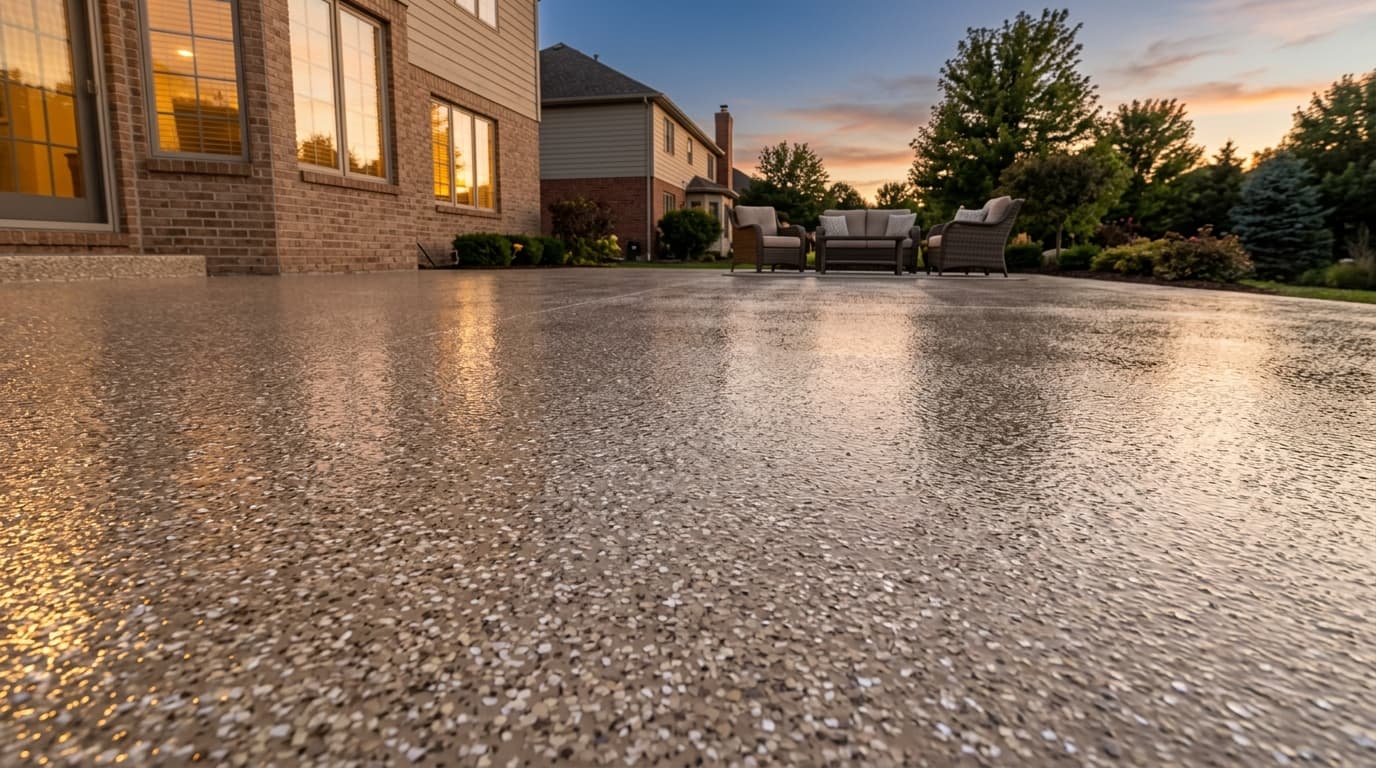
The metallic character comes from the flake itself. Iridescent chips catch and scatter light differently than the matte chips around them, so the surface shifts tone as the sun moves and as you walk across it. Because the shimmer lives in the flake and the flake is sealed under the polyaspartic topcoat, it isn't a surface treatment that can wear off — it's inside the system.
Install time on a typical 300–600 sq ft patio is one day. Light foot traffic that evening; furniture back the next day.
What does a metallic-look flake patio actually look like?
A metallic-look flake patio reads as a speckled, terrazzo- or granite-like surface with visible depth and a shimmer that shifts tone under changing light. At normal standing distance it looks like a rich architectural stone floor with movement in it. Up close you can see the individual chips. That is genuinely beautiful, and it is genuinely not the same thing as metallic epoxy.
Metallic epoxy achieves its look differently: metallic pigments are blended into liquid epoxy and manipulated while wet, producing a fluid, marble-like, high-gloss swirl with no visible texture. Flake produces depth through thousands of discrete chips. Swirl versus speckle. Both look expensive; they don't look alike.
We're explicit about this on every estimate because the disappointment we want to avoid is a homeowner who saw a metallic epoxy photo on social media, said "metallic," and pictured swirl. If liquid-marble swirl is specifically what you want, a flake system will not deliver it — and as the next section covers, neither will metallic epoxy on an Ohio patio, for reasons that have nothing to do with who installs it.
Can you put metallic epoxy on an outdoor patio in Ohio?
You should not put metallic epoxy on an outdoor patio in Ohio, regardless of who installs it. Metallic epoxy is not UV stable. Outdoors, sunlight photodegrades the polymer chains — the finish ambers and fades, the metallic effect goes flat and muddy, and the coating embrittles until it cracks and delaminates. This is a material property of epoxy, not a workmanship issue, and no installer's technique changes it.
Add Ohio's freeze-thaw cycle and it gets worse. Epoxy is rigid; a Northeast Ohio slab moves through a hundred-plus freeze-thaw cycles a year. Rigid coating over moving slab produces cracking, and the cracks in a high-gloss metallic finish are extremely visible.
Diamond Concrete Coating does not install metallic epoxy, UV-reactive overlays, stamped concrete, or polished concrete — we install polyurea and polyaspartic systems only. That's a limitation on what we sell, and we'd rather tell you why than sell you something that looks incredible for two summers.
How much does a metallic-look flake patio cost in Ohio?
A metallic-look flake polyaspartic patio costs $7–$10 per square foot installed in Northeast Ohio — one range covering the whole decorative program, with no metallic surcharge stacked on top. Solid satin colors sit at the low end of the range, multi-color and metallic-look blends at the top. Here's what that means on real patio sizes, with the square footage shown so you can check the arithmetic.
- ✓Entry slab or small side patio — 200 sq ft — $1,400–$2,000 installed
- ✓Standard back patio — 300 sq ft — $2,100–$3,000 installed
- ✓Larger back patio — 400 sq ft — $2,800–$4,000 installed
- ✓Wraparound or outdoor living space — 600 sq ft — $4,200–$6,000 installed
- ✓Full outdoor living area — 800 sq ft — $5,600–$8,000 installed
What moves you inside the range is the slab and the layout, not the flake. A newer, sound, rectangular slab prices low; a salt-pitted slab with a failed stain to grind off, curves, planters, and multiple step-downs prices high. Larger patios carry a lower per-square-foot rate because setup cost spreads further. Every quote is flat-rate — nothing gets added on install day. Full system details are on our outdoor patios and entryways service page.
Which flake palettes are working on Ohio patios in 2026?
The dominant 2026 direction for outdoor concrete is warm and natural — warm grays with earthy undertones, stone-inspired tans, and soft neutrals, moving away from the cool industrial gray that defined the previous several years. Metallic-look flake fits inside that direction as the shimmer option, not as a replacement for it.
- ✓Warm neutral with pearl accent — tan and soft-gray base with iridescent chips scattered through it. The most requested 2026 combination, and the easiest to live with next to brick, stone, and natural landscaping.
- ✓Charcoal and silver — cool, modern, high contrast. Strong on shaded patios and against contemporary architecture. Runs hotter underfoot in full sun than lighter blends.
- ✓Espresso and copper — deep browns with warm metallic chips. Reads rich under evening lighting and pairs well with wood-toned pergolas and outdoor kitchens.
- ✓Driftwood and platinum — pale, weathered, soft shimmer. The most understated of the metallic-look blends, and the one most likely to look at home on a lakefront or wooded lot.
- ✓Solid satin color — no flake shimmer, clean and quiet, at the low end of the price range. Still the right call on some patios, and we'll say so.
We bring physical flake samples to every estimate and set them on your actual slab, in your actual light, next to your actual house. A flake blend under showroom lighting and the same blend on a north-facing patio in Westlake at 4 PM are two visibly different things, and the sample walk is worth the twenty minutes.
Where does metallic-look flake work best outdoors — and where would we steer you elsewhere?
Metallic-look flake works best where light moves across the surface through the day: open back patios, covered porches with afternoon sun, entryways under a portico, and outdoor living spaces used at dusk under warm lighting. The shimmer needs changing light to do anything, which is why a patio that gets a mix of sun and shade shows it off better than one in flat, constant shade.
Where we'd steer you differently: on a pool deck in full southern exposure, we generally push toward lighter tans and grays over dark metallic blends, because dark surfaces run meaningfully hotter underfoot. Our Medina pool deck coating guide covers that trade-off in detail. And if the look you're actually after is natural stone rather than shimmer, a multi-color earth-tone blend gets you there more convincingly — our comparison of polyaspartic flake versus stamped concrete for Ohio patios covers those blends.
Will the shimmer fade under Ohio sun?
No. The metallic-look flake in a Diamond patio sits underneath a UV-stable polyaspartic topcoat, which is the layer that takes the sunlight. Unlike epoxy, polyaspartic does not amber, fade, or chalk under UV exposure, so the shimmer and the color stay as installed. The system carries a 15-year warranty against peeling, delamination, and material failure — non-prorated and transferable to the next owner if you sell.
Maintenance is genuinely minimal: rinse it, sweep it, and keep calcium chloride deicers off it in winter. No annual resealing, unlike the topical sealer a stamped concrete patio needs every two to three years.
Book a Flake Sample Walk-Through — Fall Install Window Is Open
Fall is the best patio install window in Northeast Ohio, and it's a chemistry reason rather than a scheduling one: relative humidity drops below the 75% threshold that shortens polyaspartic pot life, temperatures sit in the ideal application band, and your patio is finished and fully cured long before spring.
Call Diamond Concrete Coating at 440-821-7220 or book a free on-site estimate, and we'll bring metallic-look and earth-tone flake samples out to your slab so you can see them in your own light before you decide. We serve Greater Cleveland, Medina County, Summit County, and the surrounding suburbs — one-day install, flat-rate pricing, 15-year warranty.
Frequently Asked Questions
Does Diamond install metallic epoxy or UV-reactive concrete?
No. Diamond Concrete Coating installs polyurea and polyaspartic systems with decorative flake only — no metallic epoxy, no UV-reactive overlays, no stamped, stained, or polished concrete. For outdoor patios in Ohio that's a deliberate choice: metallic epoxy is not UV stable, so it ambers, fades, and embrittles outdoors regardless of who installs it. Metallic-look flake delivers shimmer and depth with a UV-stable topcoat over it.
Will a metallic-look flake patio look like metallic epoxy?
No — and it's worth knowing that before your estimate. A metallic-look flake patio reads as speckled, terrazzo-like depth with a tonal shift under changing light. Metallic epoxy produces a fluid, marble-like swirl with no texture. Both look high-end; they look different. Flake also gives you permanent mechanical traction, which a smooth metallic epoxy surface does not.
Does metallic-look flake cost more than a standard flake blend?
No. Metallic-look flake sits inside the same $7–$10 per square foot installed range as every other Diamond patio finish, with no separate upgrade fee. Solid satin colors sit at the low end of the range and multi-color and metallic-look blends sit toward the top of it, but a 400 sq ft patio is $2,800–$4,000 either way. What actually moves a patio quote is slab condition, layout complexity, and size — not the blend you pick.
Will the metallic flake fade in the sun?
No. The flake is sealed beneath a UV-stable polyaspartic topcoat, which takes the sun exposure instead of the decorative layer. Polyaspartic does not amber, chalk, or fade under UV the way epoxy does, so the shimmer and color stay as installed. The system carries a 15-year non-prorated, transferable warranty against peeling, delamination, and material failure.
Can metallic flake be added to an existing polyaspartic patio?
Yes, during a recoat. Adding metallic-look flake to an existing polyaspartic patio means re-broadcasting flake and applying a fresh polyaspartic topcoat over it rather than dusting shimmer onto the current surface. We evaluate the existing coating's condition and bond at the estimate first — if the existing system is failing rather than simply dated, grinding it off and reinstalling is the better answer.
Is a metallic-look flake patio slippery when wet?
A metallic-look flake patio gets its traction from the flake broadcast itself, which creates permanent mechanical texture built into the coating rather than an additive sitting on the surface that wears away. On patios, pool surrounds, and entryways that get wet regularly, we also add a slip-resistant additive to the polyaspartic topcoat at no extra charge. We specify the level of texture with you at the estimate based on how the space is used and who uses it.