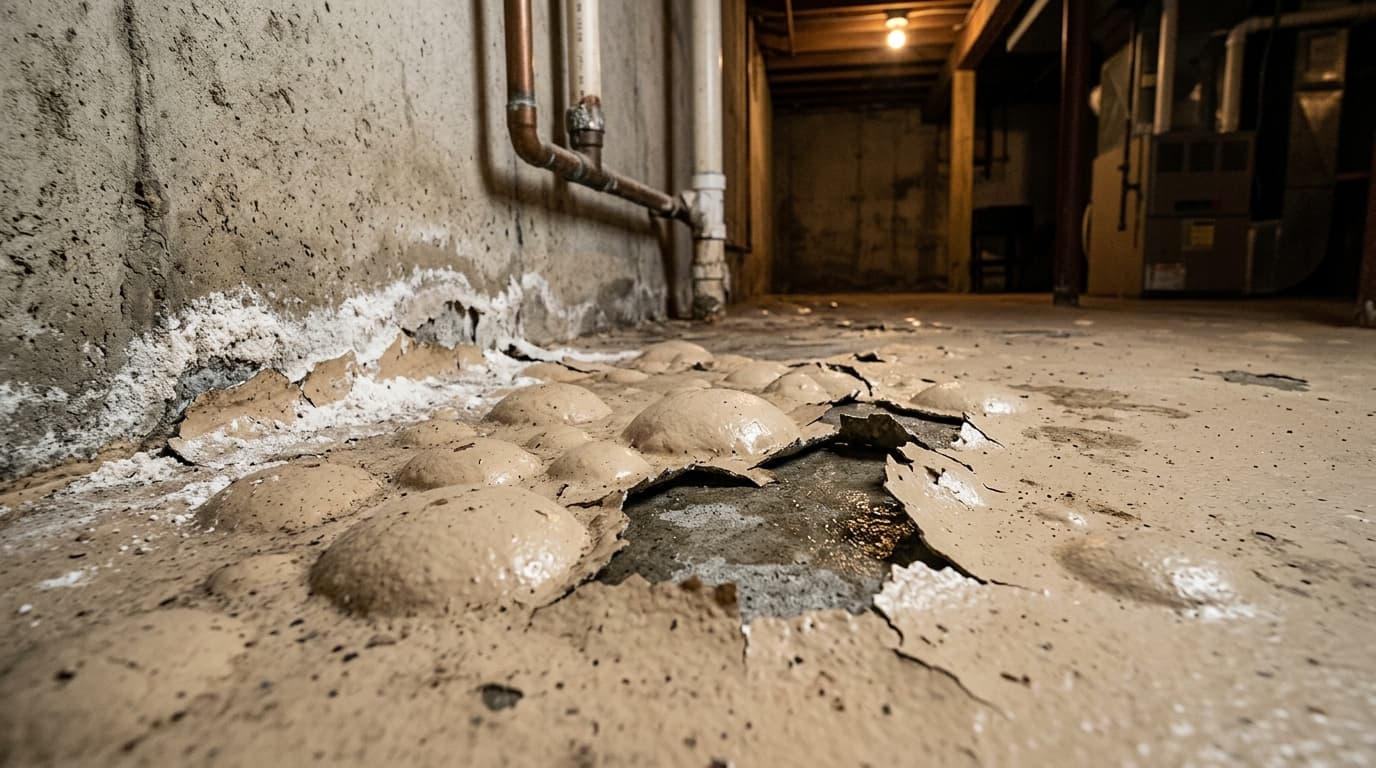
An epoxy basement floor peels in Ohio because water vapor moves upward through the concrete slab continuously, and epoxy is effectively a vapor barrier. The vapor cannot pass through the coating, so it collects at the bond line between the epoxy and the concrete, builds pressure, and lifts the film off the floor from underneath. The epoxy didn't fail. It got pushed off.
This is the single most common coating failure we're called about in Cleveland-area basements, and it's the one homeowners most often misdiagnose — because from above it looks like a product defect or a bad install, and the contractor who did the work is often long gone. The underlying soil-and-water mechanism is covered in depth in our guide to why basement floor coatings fail in Ohio clay soil. This post is about the epoxy-specific part: how to confirm vapor drive is what happened to your floor, and what to put down instead.
What peeling epoxy looks like in a basement
Basement epoxy failure looks different from garage epoxy failure, and the difference is diagnostic. In a garage, coatings usually let go at the door lip and in the tire paths — mechanical and chemical stress from outside. In a basement there's no salt, no hot tires, and no UV, so when a basement floor fails, the stress came from underneath.
- ✓Blisters and bubbles in the open field of the floor, not at the edges — the classic vapor-drive signature.
- ✓Bubbles that feel soft or hold liquid when pressed, and that reappear in the same spots after being cut open.
- ✓Coating lifting in irregular islands rather than along a straight line or a traffic path.
- ✓Chalky white powder — efflorescence — under the lifted coating or around its edges.
- ✓Darker, damp-looking concrete revealed under the peel, which dries to a lighter shade over hours.
- ✓Failure concentrated near the perimeter walls, around the sump or floor drain, or in one low corner.
Why epoxy specifically loses to vapor drive
Every coating has a permeability rating — a measure of how readily water vapor passes through it. Epoxy sits at the low end, which is exactly the property that makes it valuable as an industrial vapor barrier and exactly the property that destroys it on an Ohio basement slab. Moisture arriving from below has two options: pass through the coating, or accumulate beneath it. With epoxy, it accumulates.
Pressure builds gradually at the weakest points of the bond, and once a blister starts it grows, because the lifted area now has a void for vapor to collect in. That's why basement epoxy failures tend to appear suddenly after a year or two of looking fine, then spread quickly. The bond was losing a slow contest the entire time.
A polyurea base coat is the counter. It's more vapor-tolerant, it stays flexible rather than curing rigid, and it's formulated to bond to concrete that is releasing moisture rather than to fight it. That is the whole argument for the system change — not that polyurea is a better product in the abstract, but that it's the right product for a slab that will never stop breathing.
Why Ohio basements are harder on coatings than most
Northeast Ohio stacks three conditions that each independently drive moisture through a basement slab. The regional soil is heavy clay, which holds water against the foundation rather than draining it away. The water table across much of Cuyahoga, Summit, and Medina counties sits high enough to keep the soil beneath the slab damp year-round. And basement slabs poured before roughly the mid-1990s in this area frequently have no vapor barrier beneath them at all.
Add the seasonal swing — a humid Ohio summer against a cool slab produces surface condensation from above at the same time vapor arrives from below — and you have a floor under moisture pressure from two directions. None of this means an Ohio basement can't be coated. It means the slab has to be measured before anything is specified.
How do I know it was moisture and not a bad install?
The two most common basement failure causes — vapor drive and inadequate surface prep — produce visibly different peels, and you can usually tell them apart yourself.
- ✓Vapor drive: blisters in the open field, damp or discolored concrete underneath, efflorescence, failure that recurs in the same locations after repair.
- ✓Prep failure: large sheets that lift cleanly, smooth glossy concrete underneath with no coating residue, dry slab, failure that follows the pattern of how the coating was rolled on.
- ✓Both at once: common on older homes, where an installer skipped moisture testing and also acid etched instead of diamond grinding.
Confirming it with a real moisture test
The homeowner version is the plastic-sheet test: tape a two-foot square of clear plastic tightly to a clean, bare section of the slab on all four edges and leave it 24 to 72 hours. Condensation on the underside of the plastic, or a darkened patch of concrete beneath it, means the slab is actively moving moisture. It's a genuine indicator and it costs nothing.
What it won't give you is a number, and the number is what a coating gets specified against. Professional testing uses either a calcium chloride test, which measures how much moisture comes out of a measured area over a set period, or an in-slab relative humidity probe drilled into the concrete, which reads the moisture condition inside the slab rather than at its surface. The in-slab probe is generally the more reliable of the two and is what manufacturers write their limits against.
Diamond moisture-tests before quoting any basement, and if the slab reads outside the range for a standard system we say so before you've spent anything — rather than coating it and finding out together in eighteen months.
Can a basement with failed epoxy be recoated?
Usually yes, and more often than homeowners expect. The failed epoxy has to come off completely — diamond grinding removes it and profiles the concrete in the same pass — and then the decision depends on what the slab measures.
A slab reading inside normal range takes a polyurea base and polyaspartic topcoat directly, at the same $7–$10 per square foot as any residential install. A slab reading high needs a moisture mitigation step first: a penetrating densifier or a dedicated moisture-vapor barrier primer applied before the base coat, which adds cost and a day to the schedule but makes the difference between a floor that holds and one that repeats the failure.
And occasionally the honest answer is that a coating isn't the right next purchase — if there's active water intrusion, a failing sump, or a drainage problem outside the foundation, that gets fixed first. Coating over an active water problem is spending money in the wrong order. We'd rather tell you that at the estimate.
What actually holds in an Ohio basement
The system that works here is a moisture-tolerant polyurea base coat under a polyaspartic topcoat, installed over a diamond-ground slab that's been moisture-tested first. The polyurea handles the vapor and stays flexible; the polyaspartic takes the abrasion and cleans easily. Full-broadcast flake adds slip resistance and hides the minor imperfections that every older basement slab has.
Installed cost is $7–$10 per square foot in Northeast Ohio, with moisture mitigation quoted on top where testing calls for it. Our complete guide to basement floor coating in Cleveland covers the process end to end, and the decorative flake options for Ohio basements walk through the finishes.
Get Your Basement Slab Moisture-Tested for Free
If your basement epoxy is blistering or peeling, the useful next step is finding out what the slab is actually doing before anyone quotes you a new floor. Diamond Concrete Coating moisture-tests every basement we quote and will tell you plainly if a coating isn't the right answer yet. Call 440-821-7220 or book a free on-site estimate.
We serve Greater Cleveland, Akron, Medina County, and the surrounding suburbs, with a 15-year non-prorated, transferable warranty on every install. More on our basement and indoor floor coating services.
Frequently Asked Questions
Is epoxy ever a good choice for a basement floor?
Epoxy performs well on interior slabs that are dry, climate-controlled, and built over a functioning vapor barrier — which describes a lot of commercial interiors and very few Ohio residential basements. The problem isn't the resin's quality, it's the pairing: a low-permeability coating over a slab that moves moisture upward is a mismatch regardless of how well the epoxy itself is made. On a basement slab that tests dry, epoxy can work. Most Ohio basement slabs don't test dry.
Can I fix basement epoxy blisters without redoing the whole floor?
Cutting out and patching individual blisters almost never holds, because the vapor that lifted the first blister is still arriving and simply moves to the next weakest point in the bond. Homeowners often describe chasing blisters across a floor for a season or two before giving up. If the cause is vapor drive, the fix is addressing the moisture and replacing the system, not repairing the symptom.
How long does it take a basement epoxy floor to start peeling?
It varies with how much moisture the slab is moving, but one to three years is the common window in Ohio basements, and failures inside the first year aren't unusual on a slab with no vapor barrier. The deceptive part is that the floor typically looks perfect during that time — the bond degrades invisibly until the first blister appears, and then spread is quick.
Does a dehumidifier stop a basement floor coating from peeling?
No. A dehumidifier manages the humidity of the air in the basement, which is worth doing for comfort and for mold control, but it has essentially no effect on vapor moving upward through the slab from the soil beneath it. That vapor is driven by the moisture content of the ground under your foundation, not by the air in the room. Running a dehumidifier will not rescue a coating that's failing from below.
Will polyurea peel in a basement the way epoxy does?
Not from vapor drive, which is the mechanism behind most Ohio basement coating failures. A polyurea base coat is vapor-tolerant and flexible, so moisture passing through the slab doesn't accumulate at the bond line and lift it. Polyurea can still fail if the slab was prepared badly, if there's active liquid water intrusion, or if moisture levels are extreme and mitigation was skipped — which is exactly why the slab gets tested before the system gets specified.
How much does it cost to replace a failed epoxy basement floor?
Replacing a failed basement epoxy floor runs the same $7–$10 per square foot as a new install in Northeast Ohio, because grinding the old coating off and profiling the slab is work a bare floor needs anyway. Moisture mitigation, where testing calls for it, is quoted in addition. A 1,000 square foot finished basement therefore typically lands in the $7,000–$10,000 range before any mitigation.