Your epoxy garage floor is peeling because the bond between the coating and the concrete underneath it failed. In Northeast Ohio that bond failure traces to one of seven causes, and six of them happened before the epoxy ever came out of the bucket — inadequate surface prep, moisture in the slab, salt contamination, or an install done outside the product's cure window. The resin is rarely the culprit. The preparation almost always is.
That distinction matters, because it decides what you do next. A coating that failed because of workmanship can be ground off and replaced with a system that holds. A coating that failed because the slab is pushing moisture will fail again in exactly the same way unless the moisture gets addressed first. This guide walks through how to tell those apart from your own garage floor, using the pattern of the peel.
Start with where the floor is peeling, not why
Before diagnosing the cause, look at the pattern. Where an epoxy garage floor lets go tells you more than any other single piece of evidence, because each failure mode has a signature location. Walk the garage and note which of these you're seeing.
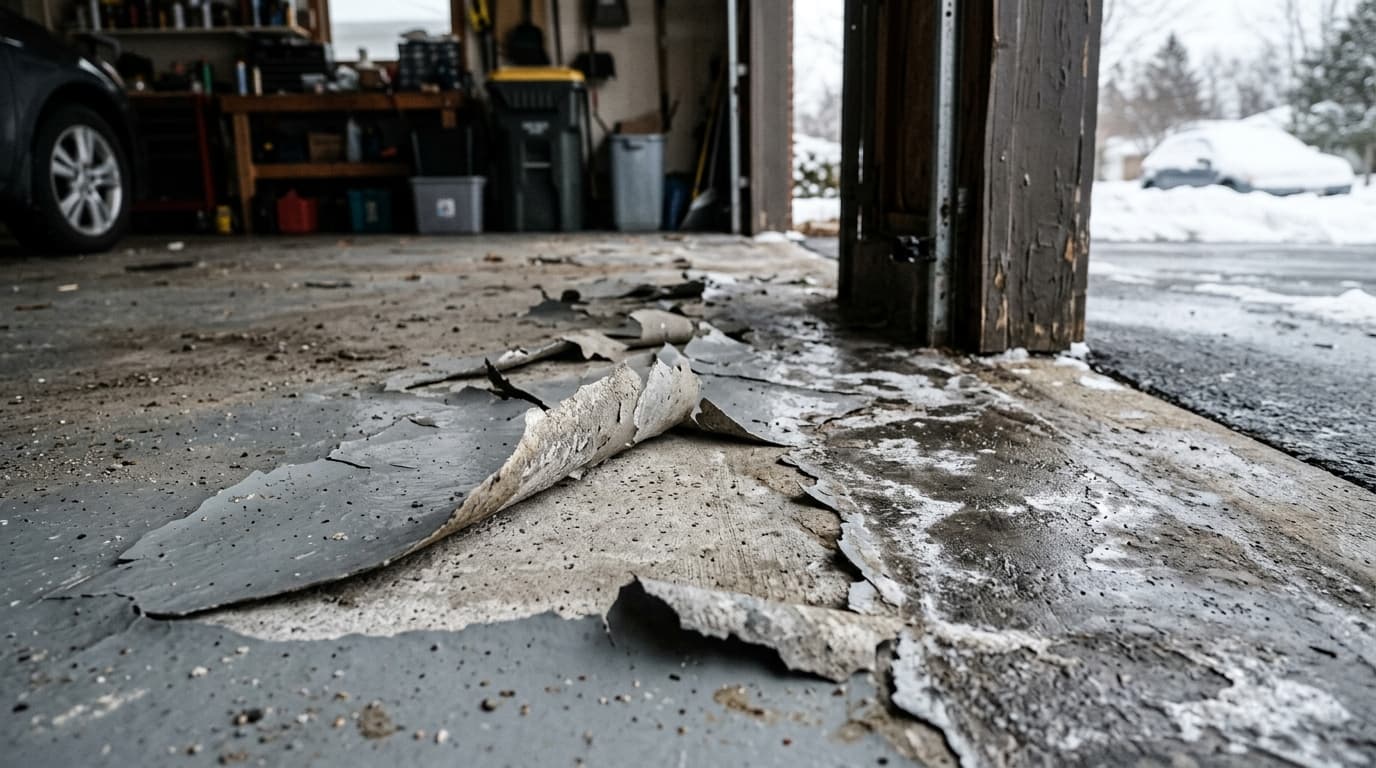
- ✓Peeling at the garage door lip, in a band 6–24 inches deep — snowmelt, road salt, and freeze-thaw at the most exposed edge of the slab.
- ✓Circular patches where the tires sit — hot tire pickup, an adhesion failure amplified by heat.
- ✓Blisters or bubbles that lift in the middle of the floor, away from any edge — moisture vapor pushing up through the slab.
- ✓Large sheets that peel away cleanly and show smooth, uncontaminated concrete on the underside — prep failure, usually acid etching.
- ✓Flaking around a floor drain, a utility sink, or the wall line — standing water or a wet slab edge.
- ✓Chalky white residue under or around the lifted coating — efflorescence, meaning water has been moving through the concrete.
The 7 causes of a peeling epoxy garage floor
Here are the seven failure causes we actually find when we grind off failed epoxy in Cleveland, Akron, and Medina County garages, roughly in order of how often they turn out to be the answer.
1. The slab was acid etched instead of diamond ground
Acid etching is the single most common reason an epoxy garage floor peels. Etching uses an acid wash to roughen the surface chemically rather than mechanically. It's fast and cheap, and it produces an inconsistent profile while leaving acid salts and residue behind in the pores of the concrete — which is to say, it leaves a contaminant between your slab and your coating.
The signature is unmistakable: the epoxy comes up in large sheets, and the concrete underneath looks smooth and clean rather than profiled. If you can peel a piece up by hand and the back of it is glossy with no concrete stuck to it, prep is your answer. Mechanical diamond grinding is the alternative, and it's not a preference — it opens the concrete to a measurable surface profile so the coating has something to key into.
2. Moisture vapor is driving up through the slab
Concrete is not waterproof. A garage slab poured on Northeast Ohio clay moves water vapor upward continuously, and if that slab was poured without a vapor barrier underneath it — which was standard practice in this area well into the 1990s — the vapor has nowhere to go but through the floor. Epoxy is effectively a vapor barrier, so the moisture collects at the bond line, builds pressure, and lifts the coating from below.
The signature here is blistering in the field of the floor, away from edges, sometimes with a chalky white efflorescence ring. Press a blister and it may feel spongy or hold liquid. This is the one cause on the list that will defeat a perfect installation, because no amount of grinding fixes a slab that's pushing water. It has to be measured and mitigated before anything gets coated again.
3. The concrete was salt-contaminated when it was coated
Calcium chloride road salt doesn't sit on top of an Ohio garage floor — it dissolves in snowmelt, wicks into the concrete, and stays there. Coating over a salt-loaded slab traps those salts at the bond line, where they continue to draw moisture and crystallize, and crystal growth under a coating exerts enough pressure to break the bond.
This shows up as peeling concentrated in the first two feet inside the garage door and in the tire paths, because that's where the salt lands. Proper prep grinds off the contaminated surface layer, which is why a garage that's been through ten Ohio winters uncoated needs more aggressive preparation than a new slab, not less. Our guide to repairing a salt-damaged garage floor covers what that remediation looks like.
4. Hot tire pickup pulled the coating off
Hot tire pickup is what happens when warm tires park on a coating that never bonded properly. The tire heats, softens the resin slightly, and cools while stuck to it — and when you back out, the coating comes with the tire in a neat circular patch. It looks like a product problem and gets blamed as one constantly.
It isn't. Hot tire pickup is an adhesion failure that heat merely exposes. A properly ground and properly cured coating with adequate film thickness does not release under a warm tire. When we find circular tire-shaped patches, we find inadequate prep underneath them essentially every time. Epoxy is more susceptible than polyaspartic because it's more thermally sensitive, but the root cause is still the bond.
5. It was installed too cold, or in the wrong conditions
Most epoxy formulations will not cure properly below roughly 50°F, and an unheated Ohio garage spends six months a year below that line. Epoxy installed on a cold slab cures slowly and incompletely, and an undercured coating never develops full adhesion or hardness — it may look finished and fail eighteen months later.
Slab temperature and dew point matter more than air temperature here. A cold slab in a humid garage can condense a microscopic film of moisture on its own surface, and a coating applied over that film is bonded to water, not to concrete. This is the failure mode that makes seasonal timing a real variable in this climate, and it's one of the practical advantages of polyurea over epoxy — polyurea cures in conditions that shut epoxy down.
6. Oil, sealer, or curing compound was left in the concrete
Anything that got into the slab before the coating went down will keep the coating from bonding to it. The three usual suspects are automotive oil that soaked into bare concrete over years of parking, a topical sealer applied when the slab was poured, and a curing compound sprayed on new concrete to slow moisture loss.
All three are invisible once dry, and all three are why a competent installer doesn't simply degrease and coat. Oil spots need to be ground out and, if deeply saturated, chemically drawn out before prep. Sealers and curing compounds have to be mechanically removed across the entire slab. A contractor who never mentions any of this while quoting a garage with a twenty-year-old oil stain in it is quoting a floor that will peel there first.
7. The coating went down too thin, or the recoat window was missed
Film thickness is a specification, not a judgment call, and thin epoxy fails early. A single-coat DIY kit spread to cover more square footage than the product allows for will wear through in the tire paths within a winter or two. Ask any contractor for the applied mil thickness of both the base and topcoat — a company installing a real system will have that number.
The related failure is a missed recoat window. Multi-coat systems have a defined window in which the next coat must go down to bond chemically to the one below. Miss it, and the coats are only mechanically stuck together — which is how a floor delaminates between layers, leaving the base coat still gripping the concrete while the topcoat sheets off. If your peel shows coating still bonded underneath, that's what happened.
Diagnosing your garage floor by symptom
Match what you're seeing to the likely cause and the likely fix. Multiple causes can and often do stack on the same floor.
- ✓Sheets lift cleanly, smooth concrete underneath — Cause: acid etching or a contaminated slab · Fix: full removal, diamond grind, recoat · Slab itself is fine
- ✓Blisters in the middle of the floor, possible white residue — Cause: moisture vapor drive · Fix: moisture testing first, then a moisture-tolerant system · Recoating without testing will fail again
- ✓Band of peeling at the garage door — Cause: salt contamination and freeze-thaw · Fix: grind past the contaminated layer, recoat with a deicer-resistant system
- ✓Circular patches in the tire paths — Cause: hot tire pickup over weak adhesion · Fix: full removal and recoat; spot repairs will not hold
- ✓Top layer sheets off, coating still bonded beneath — Cause: missed recoat window · Fix: removal of the delaminated layer, full recoat
- ✓Wear-through in traffic paths with no lifting — Cause: film too thin · Fix: recoat at spec thickness if the bond is otherwise sound
Can a peeling epoxy garage floor be patched, or does it all have to come off?
In almost every case the failed coating has to come off entirely. This is the answer homeowners least want to hear and it's the honest one: peeling is a bond failure, and a bond failure is rarely confined to the visible area. The coating around a peeled patch is usually already compromised and simply hasn't been pulled loose yet. Patching bonds new material to a failing edge, and the repair lifts at its perimeter within a season.
There is one narrow exception. If the coating is genuinely sound everywhere except a small, clearly bounded area with an identifiable local cause — a single oil spot, a spot where a water heater leaked — a spot repair can hold. The test is whether the surrounding coating passes a pull test. If it lifts when you work a blade under the edge, it's coming off too.
The good news is that removal is routine. Diamond grinding takes the old coating off and simultaneously does the preparation the original install skipped, so removal and prep are largely the same operation rather than two separate costs.
What a proper recoat looks like after an epoxy failure
Replacing a failed epoxy garage floor in Northeast Ohio runs the same $7–$10 per square foot as a new install, because grinding off the old coating and profiling the slab is work that a bare slab needs anyway. What changes is the diagnostic step at the front — the failure has to be explained before the new system is specified, or it repeats.
A correct sequence looks like this: identify the failure cause, moisture-test the slab, diamond grind the entire floor down to clean profiled concrete, repair cracks and spalls, then install a polyurea base coat under a polyaspartic topcoat. The polyurea matters specifically because it tolerates the vapor drive that defeats epoxy, and it cures in cold conditions where epoxy won't. Our full comparison of polyaspartic versus epoxy for Ohio winters covers the chemistry, and replacing an epoxy garage floor with polyaspartic walks through the transition specifically.
If you want the background on why we don't install epoxy at all in this climate, we wrote that up in why we use polyurea instead of epoxy.
Get Your Failing Garage Floor Diagnosed for Free
If your epoxy garage floor is peeling, blistering, or lifting at the door, Diamond Concrete Coating will come out, identify the actual failure cause, and moisture-test the slab before quoting anything. Call 440-821-7220 or book a free on-site estimate online.
We serve Greater Cleveland, Akron, Medina County, and the surrounding suburbs at flat-rate $7–$10 per square foot pricing, with a 15-year non-prorated, transferable warranty on every install. Most estimates are scheduled within 48 hours. Full details on our garage floor coating service page.
Frequently Asked Questions
Is a peeling epoxy garage floor covered under warranty?
That depends entirely on the warranty's structure rather than its advertised length. Many garage floor warranties cover only manufacturing defects in the resin, which excludes the preparation failures that cause the large majority of peeling — meaning the most common cause of failure is the one most commonly not covered. Check whether your warranty names peeling and delamination specifically, whether it is prorated, and whether it survived the sale of the house if you bought the home with the floor already in it.
Can I just paint or recoat over peeling epoxy?
No. A new coating applied over a failing one bonds to the failing one, so it lifts on the same schedule and takes the new material with it. Any recoat has to start with mechanical removal of the old system down to clean, profiled concrete. Coating over a peeling floor is the most expensive shortcut in this category, because it means paying for the same floor twice.
How long should an epoxy garage floor last in Ohio before peeling?
Professionally installed epoxy realistically lasts 2–5 years in an unheated Northeast Ohio garage before ambering, hot-tire pickup, or peeling at the door lip. DIY hardware-store kits commonly fail in the first or second winter. If your epoxy floor started lifting inside the first year, that points to a preparation or moisture problem rather than normal wear, and it is worth diagnosing properly before spending money on a replacement.
Does peeling epoxy mean my concrete slab is damaged?
Usually not. In most cases the concrete underneath a peeled coating is perfectly sound and simply wasn't prepared correctly. The exceptions are salt-damaged slabs with surface spalling, and slabs with active moisture problems — the first needs the deteriorated layer ground away and the surface rebuilt, and the second needs the moisture source understood before anything is coated. Both are diagnosable in a single site visit.
Why does my epoxy floor peel only at the garage door?
The garage door lip is the harshest few feet of the slab. It takes direct snowmelt and calcium chloride off vehicle tires, the most freeze-thaw cycling, standing water where the door seal sits, and UV exposure every time the door opens. Salt that wicked into that band before coating is the usual mechanism — it draws moisture and crystallizes under the film until the bond breaks. Grinding past the contaminated layer is what prevents the repeat.
Will polyaspartic peel like my epoxy did?
Not for the same reasons, provided the prep is done properly. A polyurea base coat is flexible where epoxy is rigid, tolerates the vapor drive that blisters epoxy from below, and cures at temperatures where epoxy will not. That removes three of the seven failure causes on this list outright. The remaining ones are all preparation and slab conditions, which is why the prep question matters more than the chemistry question — any system installed over an unprepared slab will fail, polyaspartic included.